
The Goethe-Zertifikat B1 Hören module has four parts and takes about 40 minutes. Teil 1 (five short texts) and Teil 4 (a discussion) are played twice. Teil 2 (an announcement) and Teil 3 (a conversation) are played once. You answer 30 items in total.
To score well, read each task before the audio starts, listen for the final information rather than the first detail you recognize, and review your mistakes by cause. This guide explains each part, ten exam strategies, common traps, and a seven-day practice plan.
Goethe B1 listening is a strategy test as well as a language test
Many learners approach the listening module with one goal: understand as many German words as possible. That sounds logical, but it is not the most effective exam strategy. In the Goethe-Zertifikat B1 Hören module, candidates must understand key messages and important details while the recording continues in real time. Successful candidates therefore need both language knowledge and a reliable listening method.
According to the Goethe-Institut, the current B1 listening module lasts approximately 40 minutes and contains four parts. Candidates hear announcements, short talks, informal conversations, and radio discussions. The official training material also confirms that learners should read each task before listening to the related recording.
The most useful Goethe B1 Hören tips are therefore not tricks. They are practical methods that help you decide what deserves your attention, what information may be a distractor, and what you can safely ignore.
This guide explains how to approach each part of the exam, how to recognize common listening traps, and how to prepare more effectively during the final week before your test.
If you only have a few minutes before the exam, start with our B1 Hören Quick Tips (in German), which cover three exam-day habits. This guide goes further and covers all four parts, ten strategies, and a seven-day plan.
First, understand what the Goethe B1 Hören module actually tests
At the B1 level, you are not expected to understand every sentence as if German were your first language. You need to follow clear standard German on familiar topics and identify the information that matters.
This distinction matters because candidates often lose points trying to understand unnecessary details.
Imagine that a recording includes a train announcement. You may hear the original departure time, the delayed departure time, the platform number, and the reason for the delay. However, the question may only ask when the train will leave.
If you try to remember every detail, you increase your cognitive load. If you read the question first, you already know which information deserves priority.
For this reason, listening preparation should train selective comprehension rather than complete transcription.
The table below shows how the module is built, based on the official Goethe-Institut practice set.
| Part | Text type | Items | Task type | Played |
|---|---|---|---|---|
| Teil 1 | Five short texts (announcements, messages, radio) | 10 (2 per text) | True/false and a/b/c for each text | Twice |
| Teil 2 | One announcement or talk | 5 | a/b/c | Once |
| Teil 3 | One conversation between two people | 7 | True/false | Once |
| Teil 4 | One discussion (host and two guests) | 8 | Assign each statement to a speaker | Twice |
Before Teil 2, Teil 3, and Teil 4, the practice set gives you 60 seconds to read the tasks. Use that time.
Goethe B1 Hören Teil 1: Do not answer after the first familiar detail
Short announcements and everyday messages can appear easy because the language often feels familiar. However, these recordings can contain information that changes during the message.
Consider this example:
Der Zug sollte um 16:10 Uhr fahren, fährt aber heute erst um 16:35 Uhr.
A learner who immediately reacts to 16:10 Uhr may choose the wrong answer. The word “aber” tells you that more important information follows.
This type of structure appears frequently in natural German communication. Speakers mention an original plan and then explain what actually happens.
Therefore, listen for the final situation rather than the first recognizable number, date or place.
Goethe B1 Hören Teil 2: Understand the purpose, then the details
Teil 2 plays one longer announcement or talk, for example, information about a course, a program, or a tour. It is played once, and five multiple-choice questions follow the order of the recording.
Start with the situation. Who is speaking, and why? The speaker may explain a problem, recommend something, describe an experience, or give practical information. This question gives you a frame for everything that follows.
Then match the details to the questions. Someone might talk about a language course, a teacher, and several classmates, while the question asks why the speaker decided to change courses. Recognizing single words is not enough. You must understand how the details relate to each other.
Goethe B1 Hören Teil 3: Follow a two-person everyday conversation in detail
Teil 3 presents a longer, informal conversation between two people talking about everyday life: a celebration, an invitation, a shared experience, or sometimes two strangers who start talking by chance. The recording is played once, and candidates answer seven true/false statements about it.
Because the conversation is informal and unscripted, speakers occasionally revise or qualify what they said earlier. A speaker might say:
Früher fand ich Online-Unterricht nicht besonders hilfreich. Inzwischen sehe ich das anders.
The first sentence expresses a negative view, but it no longer reflects the speaker’s current position. Words such as “aber,” “jedoch,” “trotzdem,” “inzwischen,” “eigentlich,” and “andererseits” often signal this kind of shift, and missing them can lead you to mark a true/false statement based on outdated information.
However, Teil 3 is not built around tracking opinion changes specifically. Its real task is detailed comprehension of an everyday dialogue. The seven statements can concern facts, plans, reasons, or feelings expressed by either speaker, not only shifts in stance. Since the recording plays only once, the more useful habit is to read all seven statements carefully during your 60 seconds of preparation time, underline what each one claims, and listen for whether the conversation confirms or contradicts it, while staying alert for contrast words that show a statement was only true at first.
Goethe B1 Hören Teil 4: Separate the speakers
Discussions become more demanding because you must follow several people at the same time. Instead of trying to remember every sentence, create a simple mental profile for each speaker.
One person may support an idea, another may disagree, and a third may accept part of both positions.
Listen particularly carefully when a new speaker begins. Expressions such as “Ich sehe das anders,” “Da stimme ich zu,” or “Für mich ist wichtiger, dass…” help you identify the speaker’s position.
This technique reduces confusion and makes longer discussions easier to organize mentally.
10 Goethe B1 Hören tips that make a real difference
Tip 1: Read for information targets, not full meaning
Before the audio, identify what each question really asks. Look for the information category: person, place, reason, time, opinion, or action. This creates a listening target.
For example, three answer choices may all mention a language course. However, the question may ask which day the course is cancelled. In that case, listen for days, dates, and cancellation language. Do not spend attention translating unrelated words.
This method reduces cognitive load. It also stops you from chasing every sentence. Strong B1 listening means selecting relevant information, not understanding every word.
Tip 2: Predict synonyms before the recording starts
The audio rarely repeats the exact words from the question. Therefore, predict simple paraphrases. If the question says “verschieben”, you might hear “einen neuen Termin machen”. If it says “günstig”, you may hear “nicht so teuer”.
Write one or two possible synonyms beside difficult keywords during practice. Over time, this builds a useful exam vocabulary network. It also protects you from distractors that copy the question wording but express the wrong idea.
Tip 3: Treat signal words as direction changes
German speakers often correct, limit, or contrast earlier information. Words such as aber, doch, leider, trotzdem, eigentlich, zuerst, dann, and stattdessen often change the answer.
Consider: “Der Kurs sollte im Mai beginnen, aber er startet jetzt erst im Juni.” May is real information. However, June gives the final start date. Therefore, do not select the first familiar detail you hear.
During Goethe B1 Hören Übungen, mark every answer that changes after a contrast word. This trains you to wait for the complete message.
Tip 4: Build a system for numbers, dates, and prices
Numbers cause errors because German places the unit before the tens in words such as “vierundzwanzig”. Similar numbers can also sound close under pressure.
Use a simple three-step routine. First, predict the unit: euros, minutes, kilometers, or a calendar date. Second, write digits instead of full words. Third, check whether the speaker corrects the number later.
Practice pairs such as 14/40, 16/60, and 17/70. In addition, practice dates with ordinal endings. Listening accuracy improves when you train confusing pairs directly.
Tip 5: Use the two listens differently in Teil 1
In Goethe B1 Hören Teil 1, each short text is played twice. Don’t use both listens the same way. During the first listen, confirm the situation and choose a provisional answer.
During the second listen, test that answer. Focus on the detail that separates the options. If you already know the answer, use the second listen to confirm it rather than restarting the whole question.
This approach prevents unnecessary doubt. It also gives you a clear task for every second listening.
Tip 6: Protect the one-listen sections: Teil 2 and Teil 3
Goethe B1 Hören Teil 2 and Goethe B1 Hören Teil 3 are played once. Therefore, preparation time before the audio is valuable. Read every question and underline the key difference between options.
Do not keep thinking about a missed answer. The recording continues, and later questions usually follow the audio order. Make your best choice, mark it, and move on.
One missed phrase should cost one question, not three. This is one of the most important B1 Hörverstehen tips for exam day.
Tip 7: In Teil 4, listen for speaker position, not isolated vocabulary
Goethe B1 Hören Teil 4 asks who expresses each statement. Therefore, build a small mental profile for each speaker. Notice whether each person supports, rejects, or qualifies the topic.
The same vocabulary may appear across several speakers. However, their positions differ. Listen for opinion markers such as “ich finde”, “für mich”, “meiner Meinung nach”, and “da bin ich anderer Meinung”.
On the first listen, map general positions. On the second listen, assign the difficult statements. This uses the repeated audio efficiently.
Tip 8: Learn the most common distractor patterns
A distractor is information that sounds relevant but does not answer the question correctly. Goethe-style listening often uses realistic distractors rather than random wrong options.
Common patterns include an original plan that later changes, a speaker quoting another person, a negative form hidden inside a longer sentence, or two similar numbers. Another common trap uses an answer word in the audio but with a different meaning.
After every practice test, label the reason for each wrong answer. “I did not know the word” is sometimes true. However, “I selected the first matching word” is often more useful.
Tip 9: Practice recovery after you miss a sentence
Good listeners also miss information. The difference is recovery speed. If you lose one sentence, return to the current question immediately. Do not replay the missed phrase mentally.
Use the next signal word, name, number, or topic change as a new anchor. This skill feels uncomfortable at first. However, it becomes easier through timed Goethe B1 listening practice.
Tip 10: Review mistakes by cause, not only score
A score tells you what happened. A mistake log tells you what to change. Divide errors into vocabulary, sound discrimination, concentration, distractor, number, question-reading, and time-pressure categories.
If most errors come from distractors, more random listening will not solve the problem. Instead, practice transcript analysis and comparing answer choices. If numbers cause errors, use short number drills before full tests.
This targeted review turns Goethe B1 Hören tips into measurable training actions.
Why “Listening more” is not always enough
Watching German television, listening to podcasts, and hearing German conversations certainly improve general comprehension. However, exam preparation requires another layer of training.
The exam asks specific questions under specific timing conditions. Therefore, you need practice that forces you to read questions quickly, predict relevant information, and make decisions while the recording continues.
A learner who spends five hours listening passively may improve general familiarity with German. Another learner who completes two realistic listening tests and analyses every mistake may improve exam performance more efficiently.
The strongest preparation combines both approaches.
A seven-day Goethe B1 Hören practice routine
Day 1: Diagnose your weaknesses
Complete one full listening practice under realistic conditions. Afterward, classify every incorrect answer instead of checking only your final percentage.
Day 2: Train numbers, times, and dates
Spend a focused session on numerical information. Listen to short announcements and write exactly what you hear.
Day 3: Practice signal words and contrast
Listen for aber, trotzdem, deshalb, sondern, jedoch, and similar expressions. Pay attention to what changes after each word.
Day 4: Practice main-idea listening
Use short news reports, interviews, or exam-style recordings. After each recording, summarise the main message in one sentence.
Day 5: Work on your weakest task type
Return to the mistake analysis from Day 1. Do not practice what already feels comfortable.
Day 6: Complete a full simulation
Follow the time limit and exam sequence without pausing or checking vocabulary.
Day 7: Review, do not overload
Review your common mistakes, useful signal words, and difficult number patterns. Avoid exhausting yourself with several full tests immediately before the exam.
The most common Goethe B1 listening mistakes
One of the most common mistakes is choosing an answer as soon as the recording contains a familiar word. This approach ignores context and makes distractors extremely effective.
Another problem is translating too much. Candidates then process yesterday’s sentence while the recording is already presenting today’s answer.
Poor time use before the recording also causes unnecessary difficulty. The official Goethe training format explicitly encourages candidates to read the task first, so you should practice this habit long before exam day.
Finally, some learners complete many exercises without analyzing mistakes. Repetition only becomes useful when it changes your future behavior.
How to use TestGerman for focused listening practice
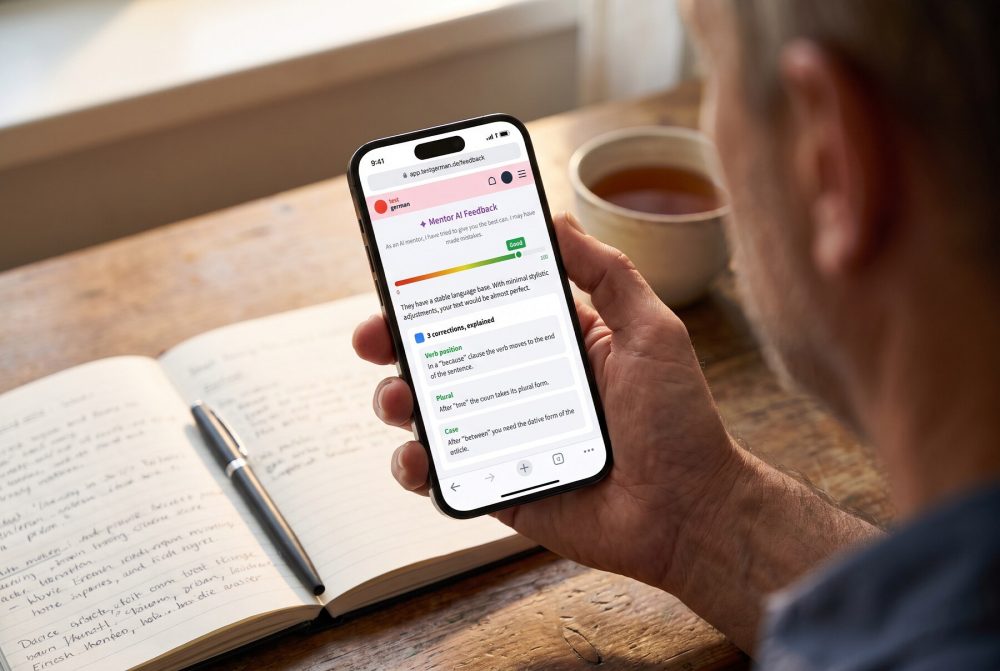
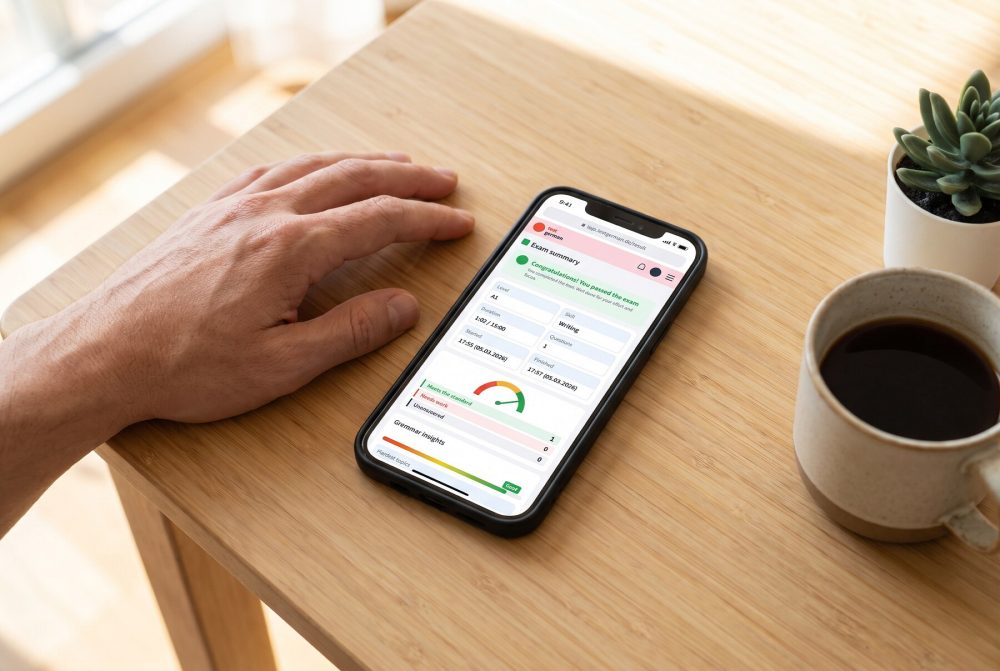
Test German provides exam-style practice across listening, reading, writing, and speaking, with a focus on Goethe, TELC, and DTZ preparation. The platform also uses exam simulations and progress data to help learners practice under structured conditions.
For listening, the most productive approach is to combine simulation with analysis. Complete the task without interruptions first. Then review the result and identify the specific listening behavior that caused each mistake.
That cycle turns listening practice into measurable exam preparation.
Start for free and practice Goethe B1 listening in exam-style conditions. No credit card. No time limit. Upgrade only if you want more.
Frequently Asked Questions About Goethe B1 Hören
FAQs About Goethe B1 Hören
The current Goethe-Zertifikat B1 Hören module contains four parts and lasts approximately 40 minutes. Candidates listen to several types of spoken German, including announcements, short talks, informal conversations, and radio discussions. The exact practice structure can be reviewed through the official Goethe-Institut B1 training materials.
Focus on question reading, signal words, numerical information, distractors and your personal error patterns. Complete at least one realistic timed simulation, but spend equal attention on reviewing why answers were wrong.
Use short, focused listening sessions rather than passive background listening. Train one problem at a time, such as times, opinions, or contrast markers, and then apply that skill during complete exam tasks.
No. B1 listening focuses on understanding key messages and relevant details rather than producing a complete transcript. Strong candidates learn to tolerate unknown vocabulary while continuing to follow the overall meaning.
It can feel harder because you cannot control the speaker and must answer specific questions under time pressure. However, the topics and language remain aligned with B1 communication. Familiarity with the exam format usually reduces much of the difficulty.
Conclusion
Effective Goethe B1 Hören tips do not promise shortcuts. They help you use the German you already know more efficiently under exam conditions.
The most important change is to stop treating listening as a test of every word. Read the question first, predict the information you need and follow signal words carefully. At the same time, learn to recognize distractors and continue listening when one word is unclear.
Finally, practise under realistic conditions and analyze your errors systematically. When you know why you lose points, your preparation becomes much more targeted.
That combination of language knowledge, exam awareness, and repeated Goethe B1 listening practice gives you a stronger foundation for exam day.
Continue your Goethe B1 preparation with our guides to B1 speaking and B1 writing, or read the complete Goethe-Zertifikat overview.