
Introduction
Many young people want to start vocational training in Germany, but they are unsure about one key question: how much German do they actually need?
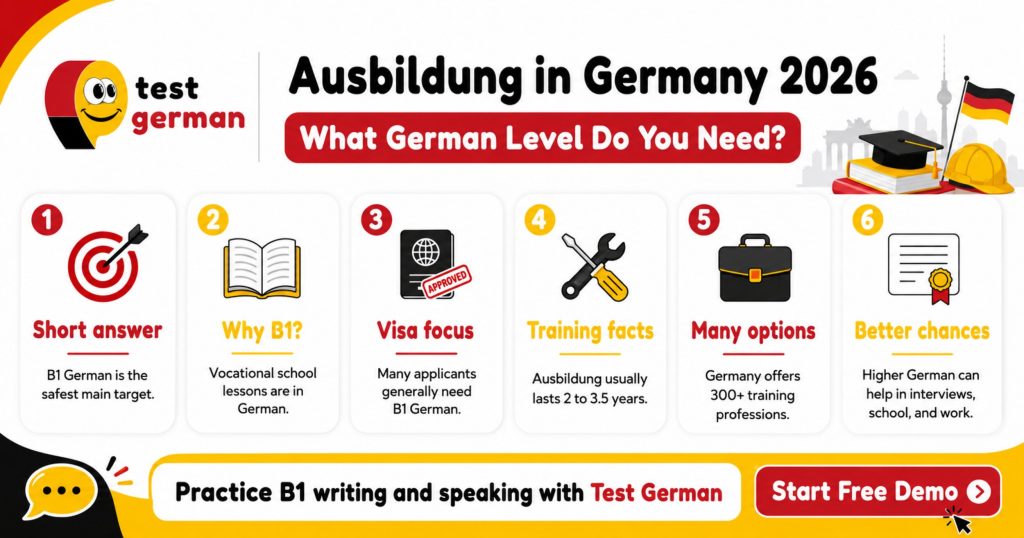
The short answer is B1. Vocational school lessons are taught in German, and the Federal Employment Agency expects trainees to follow them without major language problems. For the training visa, German skills at level B1 (CEFR) are the standard requirement.
Some professions ask for more. Nursing, customer-facing roles, and technical jobs often need stronger speaking and writing, so B2 can make your life much easier. B1 is the minimum; B2 is the comfortable level.
This guide explains the language levels clearly and gives you a simple study plan if you are still at A2 or B1.
What is Ausbildung?
Ausbildung is Germany’s dual vocational training system. It combines paid work with school: you learn a profession inside a company and study the theory at a vocational school called the Berufsschule.
Training usually lasts between two and three and a half years. You build practical skills on the job and learn the underlying theory in class. Germany recognizes more than 300 official training professions, so the range of options is wide.
The benefits are real: hands-on experience plus a recognized qualification at the end. But the whole system runs on communication. You talk with trainers, follow lessons, and read work instructions every single day. That is why your German level matters from the very first week.

Which German level do you need?
For most qualified vocational training, B1 is the safe answer. Lessons take place in German, and visa applicants for qualified training generally need German at level B1 of the CEFR.
The legal basis is the training visa under Section 16a of the Residence Act (§16a AufenthG). A2 is only relevant in one specific case: non-qualified or assistant (Helfer) training, where some authorities accept it. For normal qualified Ausbildung, plan for B1 or higher.
Here is a realistic overview by field:
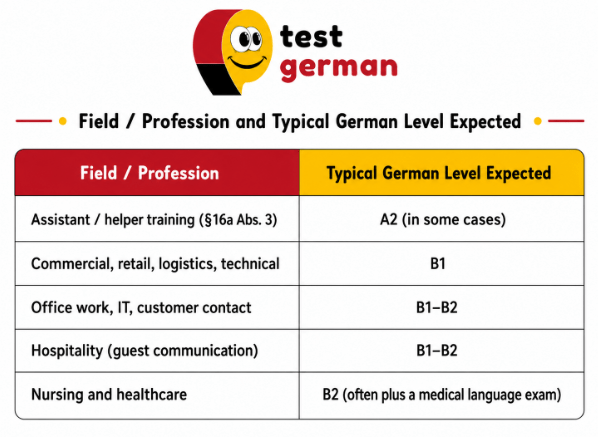
You must prove your level with a recognized certificate, such as Goethe-Zertifikat, telc, ÖSD, or TestDaF. A useful detail: if you do qualified in-company training, you may be allowed to attend a preparatory German course in Germany before the training starts, so you can reach the required level on-site.
Can you start Ausbildung with A2 German?
This is one of the most common questions about the Ausbildung visa in Germany, and the honest answer is “usually not.” For qualified vocational training, the German level for Ausbildung starts at B1. A2 is accepted only in the narrow case of non-qualified or assistant (Helfer) training under §16a Abs. 3, and even then only if the authority agrees.
If you are still at A2, the smart move is to keep that level as a starting point, not as your application level. Many applicants who try to enter with weak German pass the paperwork stage but then struggle badly in the first semester of Berufsschule. Reaching B1 before you apply protects both your visa chances and your confidence on day one.

Why Berufsschule makes German important
Many learners focus only on the company and forget the school side. The Berufsschule is just as important. Teachers explain theory in German; you write tests, read technical texts, and sometimes give short presentations.
This means speaking alone is not enough. You also need solid reading and writing: you might read safety rules, write a short report, or explain a problem in your own words. Ausbildung is not only about holding a certificate—it is about performing in German every day.
If you only memorize grammar rules, the first semester can feel overwhelming. Practice real tasks instead: write emails, describe problems, and rehearse interview answers.
From A2 to B1: the smart path
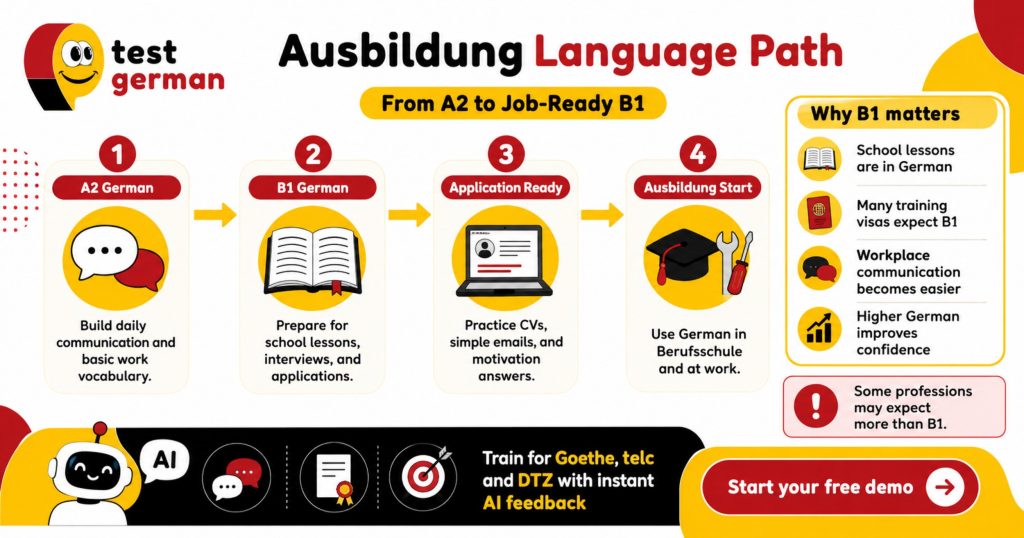
If you are at A2, there is no reason to panic. You can still build a strong plan.
At A2, focus on daily life: appointments, directions, and basic work vocabulary. At B1, shift to reasons and explanations — for example, learning to say why you want a particular profession.
A few B1 phrases that work well in interviews:
- „Ich interessiere mich für diesen Beruf.” (I am interested in this profession.)
- „Ich habe bereits Erfahrung gesammelt. “ (I have already gained experience.)
- „Ich arbeite gern im Team.” (I enjoy working in a team.)
- „Ich möchte meine Deutschkenntnisse weiter verbessern. “ (I want to keep improving my German.)
- „Ich kann zuverlässig und pünktlich arbeiten.” (I can work reliably and on time.)
The phrases look simple, and that is the point: clear, correct German leaves a better impression than complicated sentences.
How to prepare your application
An Ausbildung application usually needs a CV, your certificates, and a motivation letter. A German language certificate is often part of the package too.
Prepare your German step by step. Start with your self-introduction. Then rehearse answers about your school and experience. Finish with your motivation: why this profession, why this company.
A common trap is writing long, complicated sentences. Short, correct sentences with clear verbs work far better — both on paper and in the interview room.
Common mistakes to avoid
- Applying too early. If your German is weak, interviews become painful. Build your speaking confidence first.
- Learning only “exam German.” Exam preparation helps, but the workplace needs everyday and professional German too. Practice both.
- Ignoring writing. You will write emails to companies and short reports during training, so practice writing every week.
- Choosing a profession without research. Some fields demand more language than others. Check the daily tasks before you commit.
Frequently asked questions
Can foreigners do an Ausbildung in Germany?
Yes. Ausbildung in Germany for foreigners is fully open to non-EU applicants. You normally need a signed training contract, proof of German (usually B1), and a training visa under §16a AufenthG. EU citizens can start without a visa.
Is A2 enough for Ausbildung in Germany?
Usually not. A2 may be accepted only for non-qualified or assistant training. For normal qualified vocational training and its visa, you need a B1.
Which certificates are accepted?
Recognized providers include Goethe-Zertifikat, telc, ÖSD, and TestDaF. Always check the exact list on the website of the German embassy where you will apply.
Do nursing and healthcare need a higher level?
Yes. Healthcare and nursing programs usually require B2, and many hospitals add a medical language exam (Fachsprachprüfung).
How long does it take to reach B1 from zero?
With consistent, intensive study, most learners need roughly nine to twelve months. Reaching B2 takes longer.
Conclusion
For visa and training readiness, vocational training in Germany usually means B1 German. B2 gives you stronger chances and helps you keep up with school and workplace tasks more easily.
Start from where you are. If you are at A2, move steadily toward B1 with daily practice. If you are already at B1, build job-specific vocabulary and interview confidence. In the end, this is not just about passing a certificate — it is about using German for real work, real school, and real life in Germany.
Practice before you apply
Many applicants discover that passing a language exam and using German at work are two very different challenges. A certificate proves a level on paper; a job interview and a Berufsschule classroom test whether you can actually speak and write under pressure. That is why regular speaking and writing practice matter so much before you apply.
With Test German, you can practice B1 writing and speaking in the real exam format, get instant AI feedback in your own language, and see clear corrections for grammar, word order, and task relevance.
Start your free Test German demo and practice B1 writing and speaking before your Ausbildung application.
For language schools and integration providers
TueEs offers a digital workspace for modern language and integration courses. It connects virtual classes, study plans, digital exercises, communication, and learning progress in one place. Explore TueEs for a structured learning experience for your students.
Disclaimer:
Dieser Blog dient ausschließlich zu Informations- und Aufklärungszwecken. Die Inhalte können durch andere Quellen überprüft werden. Der Autor übernimmt keine rechtliche Verantwortung für Entscheidungen, die auf Grundlage dieser Informationen getroffen werden.