
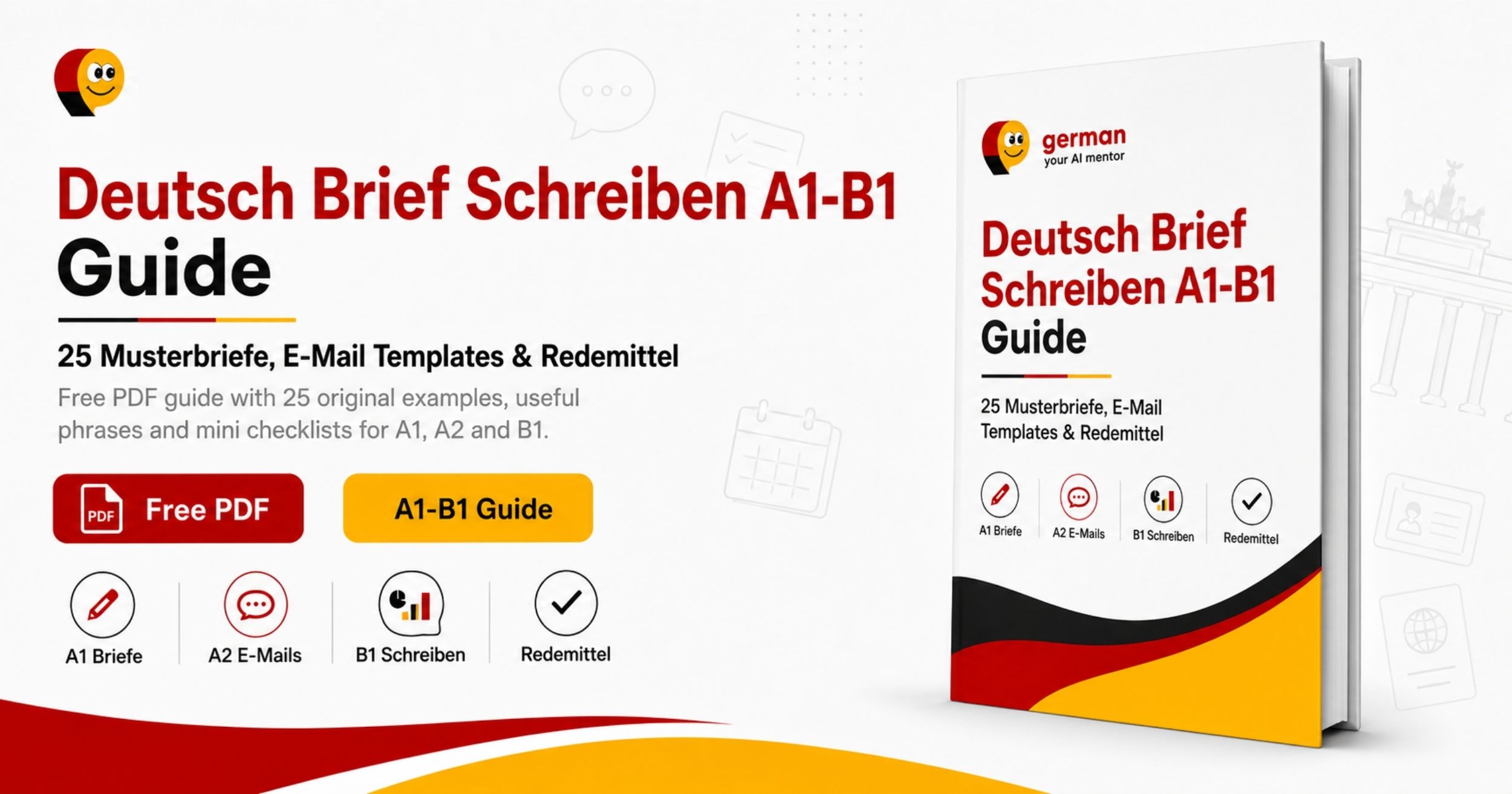
Why this Deutsch Brief Schreiben A1-B1 Guide helps
The Deutsch Brief Schreiben A1-B1 Guide helps German learners write clearer messages, e-mails, and letters. Many learners understand simple German. However, writing a correct message can still feel difficult. You need the right greeting, the right tone, clear sentences, and a polite closing. Therefore, this PDF gives you simple examples you can study and reuse.
At the A1, A2, and B1 levels, you do not need to write perfect German. You need to answer the task clearly. You also need to choose formal or informal language correctly. Because of this, the guide shows you how to write short messages, everyday e-mails, and B1 exam-style letters step by step.
This guide is useful for learners who prepare for Goethe, telc, DTZ, integration courses, daily life in Germany, or school writing tasks. In addition, it helps you understand how German letters are structured in real situations.
Deutsch Brief schreiben for A1, A2, and B1 learners
The Deutsch Brief Schreiben A1-B1 Guide is divided into simple sections. First, you learn how to choose between formal and informal writing. Then, you see common greetings, useful phrases, connectors, and short model texts.
For example, if you write to a friend, you can use “Liebe Anna” or “Hallo Max.” However, if you write to a doctor, school, landlord, office, or company, you need formal language. In this case, phrases like “Sehr geehrte Damen und Herren” and “Mit freundlichen Grüßen” are more suitable.
This difference is very important. Many learners lose points because they use the wrong tone. Therefore, this PDF gives clear examples for both situations.
A1 Schreiben: short messages and simple communication
At the A1 level, writing should be short and clear. You usually write simple messages about daily situations. For example, you may need to say that you are sick, late, or unable to come to class.
The guide includes A1 Musterbriefe for common topics such as sickness, invitations, doctor appointments, shopping, meeting places, and hotel notes. These examples help you understand what to write and how much to write.
At this level, your goal is not long writing. Instead, your goal is simple communication. You should say who, what, when, where, and why. Because of this, the guide gives short texts with mini checklists.
A2 Schreiben: everyday e-mails and practical letters
At the A2 level, learners need more details. You may need to write to a language school, doctor’s office, landlord, neighbor, Jobcenter, or customer service. Therefore, A2 writing needs a reason and one clear request.
The PDF includes A2 letter examples about changing an appointment, noise from a neighbor, course absence, package problems, birthday invitations, apartment repairs, Jobcenter appointments, and school messages.
These examples are useful because they show real-life German. You can learn how to describe a problem, explain the reason, and ask for help politely. In addition, the guide helps you use simple connectors like “weil,” “deshalb,” “trotzdem,” and “außerdem.”
B1 Schreiben: complete e-mails, opinions, and complaints
At the B1 level, writing needs more structure. You should answer all task points. You should also use paragraphs, connectors, reasons, and polite language. Therefore, the Deutsch Brief Schreiben A1-B1 Guide includes B1 Musterbriefe for exam-style writing.
Inside the B1 section, you will find examples for informal e-mails, course information requests, product complaints, travel complaints, internship questions, opinion texts, authority appointments, visits with friends, and course feedback.
These examples help you write more complete answers. They also show you how to organize ideas clearly. For B1 writing, this is very important because examiners look at task completion, structure, grammar, vocabulary, and tone.
Redemittel and useful German phrases
The PDF also includes practical Redemittel that you can reuse in different letters. These phrases help you start, connect, and finish your writing.
Because these phrases are reusable, they make writing easier. You do not need to create every sentence from zero. Instead, you can build your answer with safe and natural sentence patterns.
Learn formal and informal German letter structure
One of the most important parts of German writing is structure. A good German message usually has four parts: greeting, reason, task points, and closing.
First, start with the correct greeting. Then, say why you are writing. After that, answer every task point. Finally, close the message politely.
This method works for A1, A2, and B1. However, your sentences become longer as your level improves. Therefore, this guide helps you build the same writing habit step by step.
Download the Free PDF 👇
PDF content summary
Inside this free Deutsch Brief Schreiben A1-B1 Guide, you will find:
- Formal and informal German e-mail structure
- A1 short message examples
- A2 everyday letter examples
- B1 e-mails, opinion texts, and complaint letters
- Useful German Redemittel
- Opening and closing phrases
- Connectors such as weil, deshalb, trotzdem, außerdem
- 25 original Musterbriefe
- Mini checklists for every writing task
- Final writing checklist for learners
- Practical writing tips for Goethe, telc, DTZ, and German courses
Practice with Test German
Reading a PDF is a strong first step. However, real progress comes from active writing practice. After you read the examples, write your own answer with a similar structure. Then, check if you answered every point, used the right tone, and connected your ideas clearly.
With Test German, you can practice German exam tasks in real exam format. You can also get instant AI feedback for writing and speaking. The feedback helps you understand grammar mistakes, word order problems, missing task points, and unclear sentences.
Test German currently supports A1, A2, and B1 exam preparation. Therefore, you can use this PDF together with real exam-style practice and improve your writing step by step.
Start your free Test German demo:
Do you also want to prepare for B1 speaking?
Read this guide too:
Goethe B2 & telc B2 Prüfung Guide: Schreiben, Sprechen, Wortschatz & Modelltest
FAQ
Is this PDF useful for Goethe A1, A2, and B1?
Yes. This PDF helps learners prepare for writing tasks at A1, A2, and B1 levels. It gives short messages, formal e-mails, informal e-mails, complaints, and opinion examples.
Is this PDF useful for telc and DTZ writing?
Yes. The guide is useful for learners preparing for the Telc and DTZ writing tasks. It helps you understand tone, structure, task points, and useful German phrases.
What is the hardest part of Deutsch Brief schreiben?
Many learners find structure difficult. They forget one task point, use the wrong tone, or stop the letter too suddenly. Therefore, this guide gives checklists and model texts.
How can I improve my German writing?
Read one example first. Then, write your own version with a similar structure. After that, check greeting, tone, task points, connectors, word order, and closing.
Can I use the Musterbriefe in my exam preparation?
Yes. You can study the Musterbriefe to learn the structure and useful phrases. However, you should always write your own answer in the exam and adapt it to the exact task.