
Introduction
You have the certificate. telc Deutsch B1, or the DTZ, maybe Goethe-Zertifikat B1. The invitation to the Vorstellungsgespräch is in your inbox.
Then someone across the table says “Erzählen Sie doch mal kurz etwas über sich” and your German disappears.
This is not a grammar problem. In the exam you had preparation time, a visible task sheet, and an examiner who was trained to wait for you. None of that exists in a Bewerbungsgespräch. The person opposite you is a Pflegedienstleitung who has 25 minutes and four more candidates today.
The good news: you already trained most of what you need. You just trained it under a different name.
What your exam already covers and what it doesn’t
This is worth checking, because the answer depends on which exam you took.
telc Deutsch B1 · Sprechen, Teil 1 — Kontaktaufnahme. You introduced yourself to a partner: name, origin, work, family, and free time. That is structurally the same task as the interview self-introduction. The register is different (informal partner vs. formal employer), but the muscle is there.
DTZ · mündliche Prüfung, Teil 1—Über sich sprechen. The closest match of all three. Origin, education, work history, languages, and plans for the future. If you passed this, you have already answered a version of the interview’s opening question under time pressure.
Goethe-Zertifikat B1 · Sprechen. Here is the gap nobody mentions: this module has no self-introduction task at all. Teil 1 is planning something together, Teil 2 is presenting a topic, and Teil 3 is discussing that presentation. Excellent training for structured monologue, which is exactly what a good “Was sind Ihre Stärken?” answer is, but you have never once practiced talking about yourself in an exam setting. Budget extra time for it.
What none of the three exams trains:
- Answering when you have no task sheet in front of you
- Talking about money
- Sounding warm rather than correct
The rest of this guide covers those.
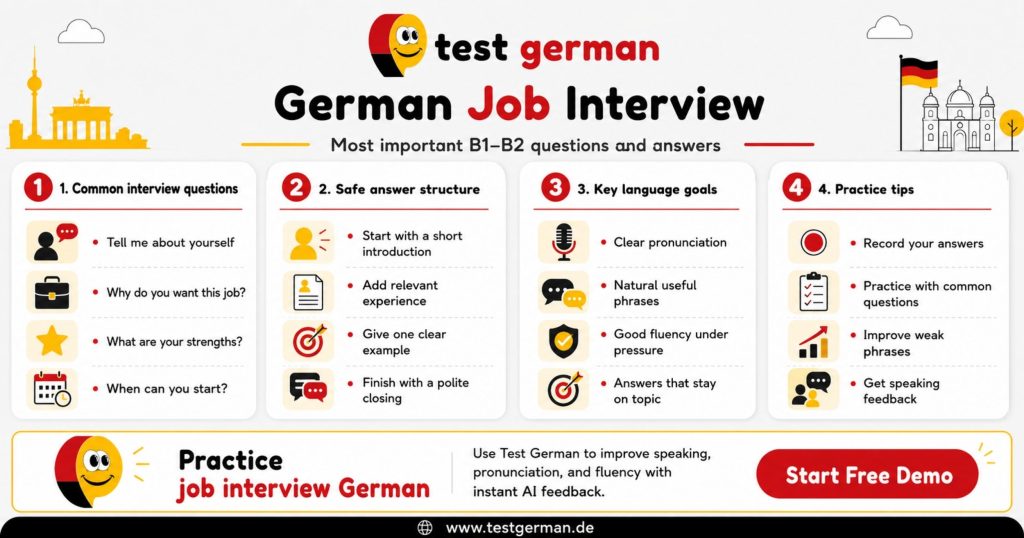
The self-introduction: four sentences, not eight
Most candidates fail this question by answering it too well. They deliver a biography starting from school. The interviewer stops listening around sentence six.
Four sentences. Profession, experience, current status, goal.
- Ich bin gelernte Pflegefachkraft und habe fünf Jahre in einem Krankenhaus in Izmir gearbeitet. Zuletzt war ich für die Aufnahme neuer Patienten zuständig. Meine Anerkennung läuft seit März; das Defizitverfahren ist beantragt. Ich suche eine Stelle, in der ich parallel zur Anerkennung schon im Team mitarbeiten kann.
- (I’m a trained nurse and worked five years in a hospital in Izmir. Most recently I was responsible for admitting new patients. My qualification recognition has been running since March and the deficit procedure has been applied for. I’m looking for a position where I can already work in the team while the recognition is ongoing.)
Notice what the third sentence does. It answers the question the employer was going to ask anyway—the Anerkennung status—before they ask it. That single sentence separates you from candidates who make the employer dig.
Swap in your own profession, and the frame holds. If you are a Mechatroniker, sentence two is a machine or a system, not a patient.

The three questions that actually decide it
Forget the list of twenty. Three questions carry the weight.
1. “Warum möchten Sie bei uns arbeiten?”
The failing answer is about you. The working answer is about them and proves you read the job ad.
Ihre Klinik bietet eine eigene Weiterbildung für Intensivpflege an—das stand in Ihrer Stellenanzeige. Genau in diese Richtung möchte ich mich entwickeln.
One specific detail from their advertisement. That is the whole trick.
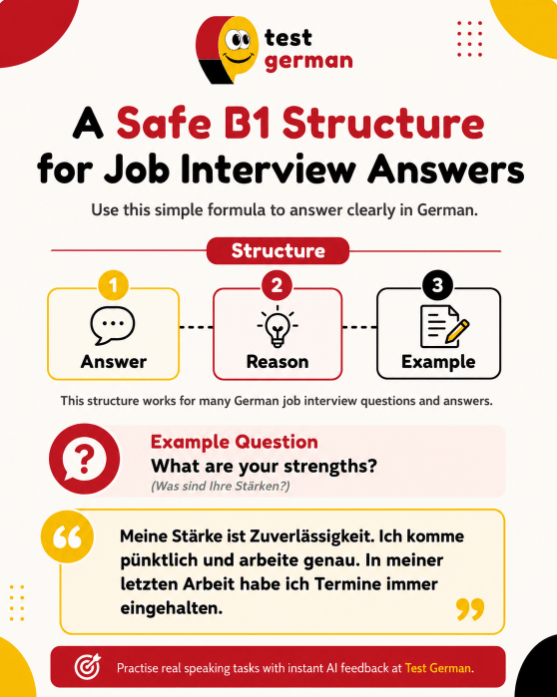
2. “Was sind Ihre Stärken?”
A strength without an example is a claim. A strength with an example is evidence.
Ich arbeite sehr strukturiert. In der Frühschicht war ich für die Übergabe zuständig und habe eine feste Checkliste eingeführt, damit nichts vergessen wird.
Claim, then situation, then what you did. Three sentences maximum.
3. “Was ist Ihre Schwäche?”
Here is the advice you will find on most other pages, and it is wrong: do not say your weakness is your German.
You are sitting in a German-language interview. Naming German as your weakness invites the interviewer to doubt the thing they were about to stop doubting. Pick a genuine professional weakness with a visible fix.
Ich neige dazu, zu viele Aufgaben selbst zu übernehmen. Seit einem halben Jahr plane ich die Schicht bewusst mit dem Team und gebe Aufgaben früher ab.
The question nobody prepares: “Was ist Ihre Gehaltsvorstellung?”
This lands in roughly the last five minutes, and it produces more panic than every other question combined.
Two rules. First, never say “Das ist mir egal”—it reads as no market knowledge, not as flexibility. Second, give a number, then a door.
Ich habe mich am Tarif orientiert und stelle mir ein Jahresbruttogehalt von etwa 38.000 Euro vor. Je nach Aufgabenbereich bin ich da aber verhandlungsbereit.
Before the interview, look up the relevant Tarifvertrag or check the salary range on the job portal you applied through. Bring one number in your head. Brutto, per year — that is the standard unit in Germany, and mixing up brutto and netto here costs you credibility instantly.
If you would rather not commit first:
Darf ich fragen, welcher Rahmen für die Stelle vorgesehen ist?

When you don’t understand the question
You will miss something. Every candidate does, including native speakers in loud rooms.
Silence is what damages you, not the misunderstanding. Four phrases, learned to the point of reflex:
- Könnten Sie die Frage bitte wiederholen? — Could you repeat the question?
- Habe ich Sie richtig verstanden—Sie meinen …?—Did I understand correctly, you mean …?
- Darf ich kurz überlegen? — May I think for a moment?
- Entschuldigung, was bedeutet “Kündigungsfrist”?—Sorry”, what does Kündigungsfrist mean?
The second one is the strongest of the four. It shows you are actively processing, and it buys you a full sentence of thinking time. It is also, incidentally, scored positively under the telc and DTZ speaking criteria as a communication strategy—so it is worth practicing even if your exam is still ahead of you.
Three mistakes, ranked by how much they cost
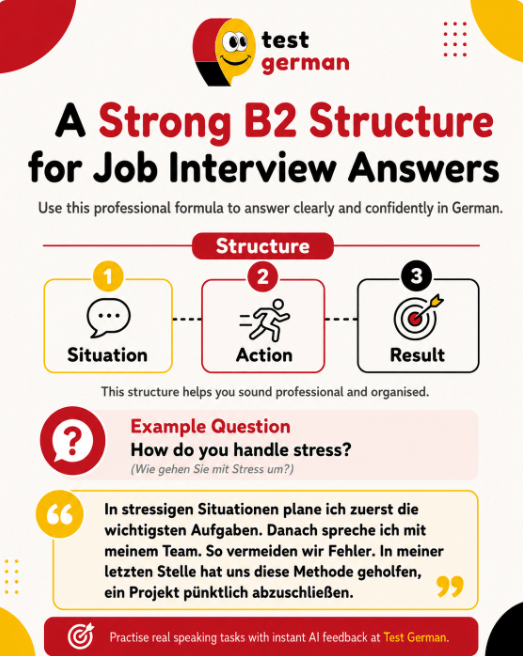
Reciting a memorized text. An interviewer can hear it. The rhythm goes flat, the eye contact drops, and the follow-up question destroys the whole thing because you only memorized the answer, not the topic. Memorize frames—the four-sentence introduction, the claim-situation-action pattern—and fill them live.
No questions at the end. “Haben Sie noch Fragen?” is not politeness; it is the last scored moment. Two questions is enough: Wie sieht ein typischer Arbeitstag aus? and Wie ist das Team zusammengesetzt? Write them on paper. Bringing notes is normal in Germany and reads as prepared, not as weak.
Speed. Nervous candidates accelerate. Slower German is not worse German — it is clearer German, and it gives you room to self-correct. If you notice yourself rushing, take the pause. Nobody has ever been rejected for a two-second pause.
What to practice, in what order
Not a seven-day plan with one task per day. Practice is uneven, because the parts are uneven.
- The self-introduction—until it is boring. Record it on your phone. Listen back once. Fix one thing. Repeat tomorrow. This one takes the most repetitions and is worth them.
- Your salary number. One evening of research. Write it down.
- Three work examples. Not answers—examples. One about structure, one about a problem you solved, and one about working with a difficult colleague. Most interview questions can be answered by pointing one of these three at the question.
- The repair phrases. Say them out loud twenty times over two days until they arrive without thinking.
- One full run-through, out loud, with someone. A friend, a Sprachpartner, an AI. Not in your head—in your head, your German is always fluent.
Where TestGerman fits into this
TestGerman is exam preparation software for Goethe-Zertifikat, telc Deutsch, DTZ and ÖSD, currently covering A1 to B1, with writing and speaking graded against the official scoring criteria.
Two things make it useful for interview preparation specifically.
The Sprechen tasks give you something the mirror cannot: you speak, and you get back a structured breakdown of task completion, vocabulary range, grammatical accuracy, and fluency—the same categories a telc or DTZ examiner works with. That feedback comes in any of 18 languages, including Turkish, Arabic, Farsi, Ukrainian, Somali, and Pashto. Reading why your Nebensatz collapsed in your own language is considerably faster than decoding the explanation in German.
And one of the B1 writing tasks in the platform is, quite literally, Bewerbungsgespräch verschieben—writing to a company to reschedule an interview appointment. Exam task, real-life task, same email.
A dedicated B1–B2 job & career roadmap is in development. If your interview is at B2 level, the current A1–B1 content will sharpen your speaking mechanics but is not built around professional scenarios yet.
Start a free Test German demo here!
Before the interview: a short checklist
- One number for the salary question, brutto, per year
- One specific detail from the job advertisement
- Three work examples
- Two questions for the employer, on paper
- The four repair phrases
FAQ
Do I need B2 for a German job interview?
It depends on the role more than on the certificate. For care work, logistics, gastronomy, and many Handwerk positions, solid B1 plus clear examples is frequently enough—employers in shortage occupations are used to interviewing at that level. For roles with customer contact, documentation duties, or team leadership, B2 makes a real difference. Ask yourself how much of the job is language, not how much of the interview is.
How long should my self-introduction be?
Around 45 seconds. Four sentences. If you go past 90 seconds, you are answering a question that was not asked.
Can I bring notes?
Yes, and it looks professional. Your questions for the employer, your salary number, and any dates from your CV. Do not read your answers from paper.
What if I make a grammar mistake?
Keep going. Interviewers are listening for whether they can work with you, not counting Dativ errors. Self-correcting once, briefly, is fine and even reads well. Correcting yourself five times does not.
Should I answer in English if the interviewer switches?
If they switch, follow them—they are usually making it easier for both sides. Then offer one or two sentences back in German later in the conversation. It signals that you are working on it rather than avoiding it.
Does TestGerman prepare me for job interviews?
Not directly, and not yet. It trains the underlying speaking and writing skills against official Goethe, telc, DTZ, and ÖSD criteria at A1–B1, which is what most of the interview mechanics rest on. The dedicated Job & Career track for B1–B2 is still in development.
Disclaimer:
Dieser Blog dient ausschließlich zu Informations- und Aufklärungszwecken. Die Inhalte können durch andere Quellen überprüft werden. Der Autor übernimmt keine rechtliche Verantwortung für Entscheidungen, die auf Grundlage dieser Informationen getroffen werden.