01 Skill One · Lesen

Reading / Lesen

The Reading Comprehension (Leseverstehen) section tests how well you can extract information from authentic German texts. Expect newspaper articles, formal letters, classifieds, and academic passages — usually under tight time pressure.

✦ what you'll practice
  • Skimming long texts to find main arguments within a 20-minute timer
  • Matching headlines to short news items and classified ads (Zuordnung)
  • Detailed comprehension: True / False / Not in text on academic passages
  • Signposting language like "im Gegensatz dazu" and "darüber hinaus"
  • Decoding compound nouns like "Krankenversicherungsbeitrag" in context
★ tips to improve
  • Read the questions before the text — you'll know what to look for
  • Don't translate every word — build tolerance for unknown vocabulary
  • Read one Süddeutsche or Spiegel article daily to train pace and register
  • Highlight signal words (aber, jedoch, allerdings) — they often mark answers
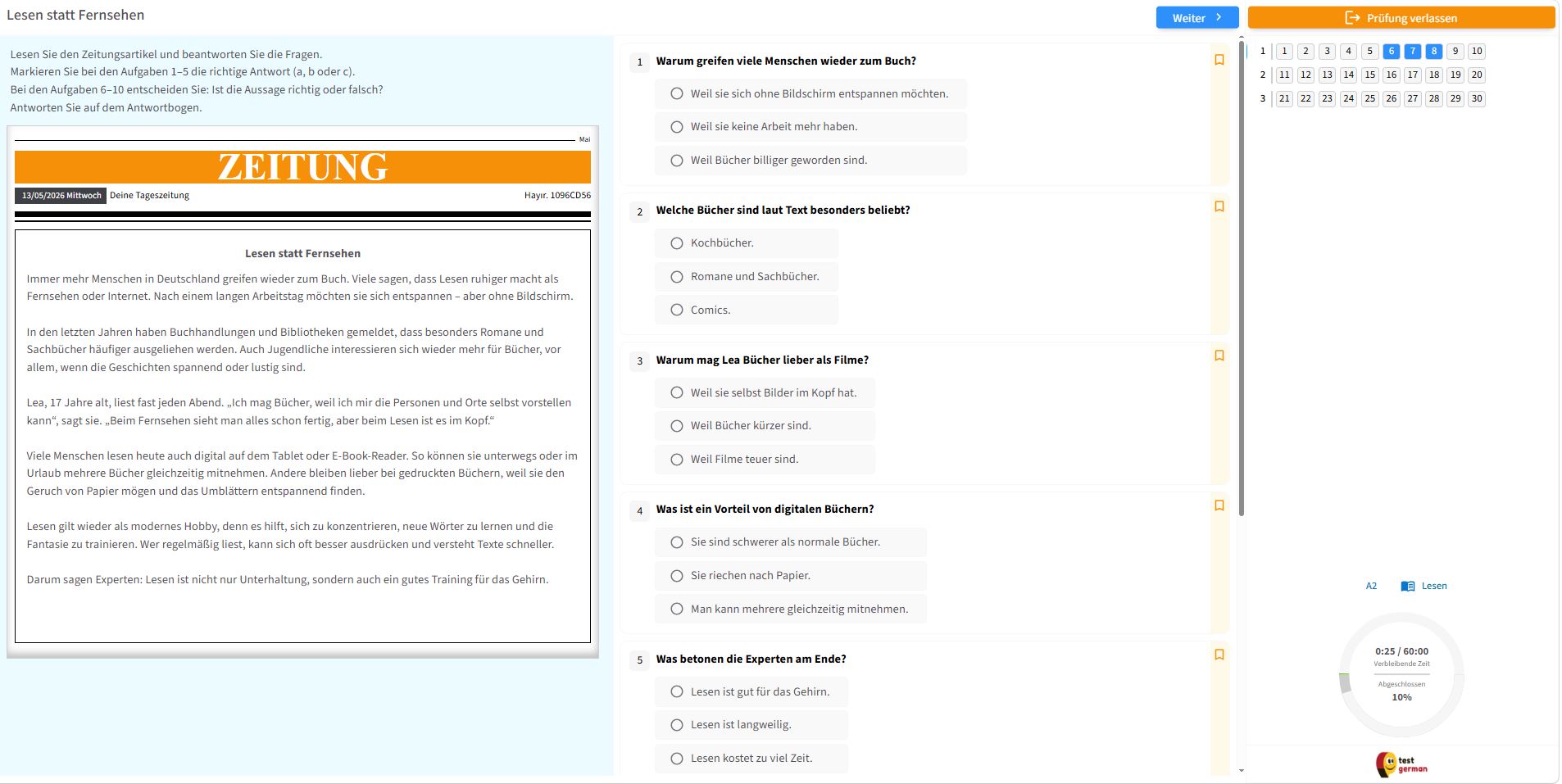
Reading exam practice
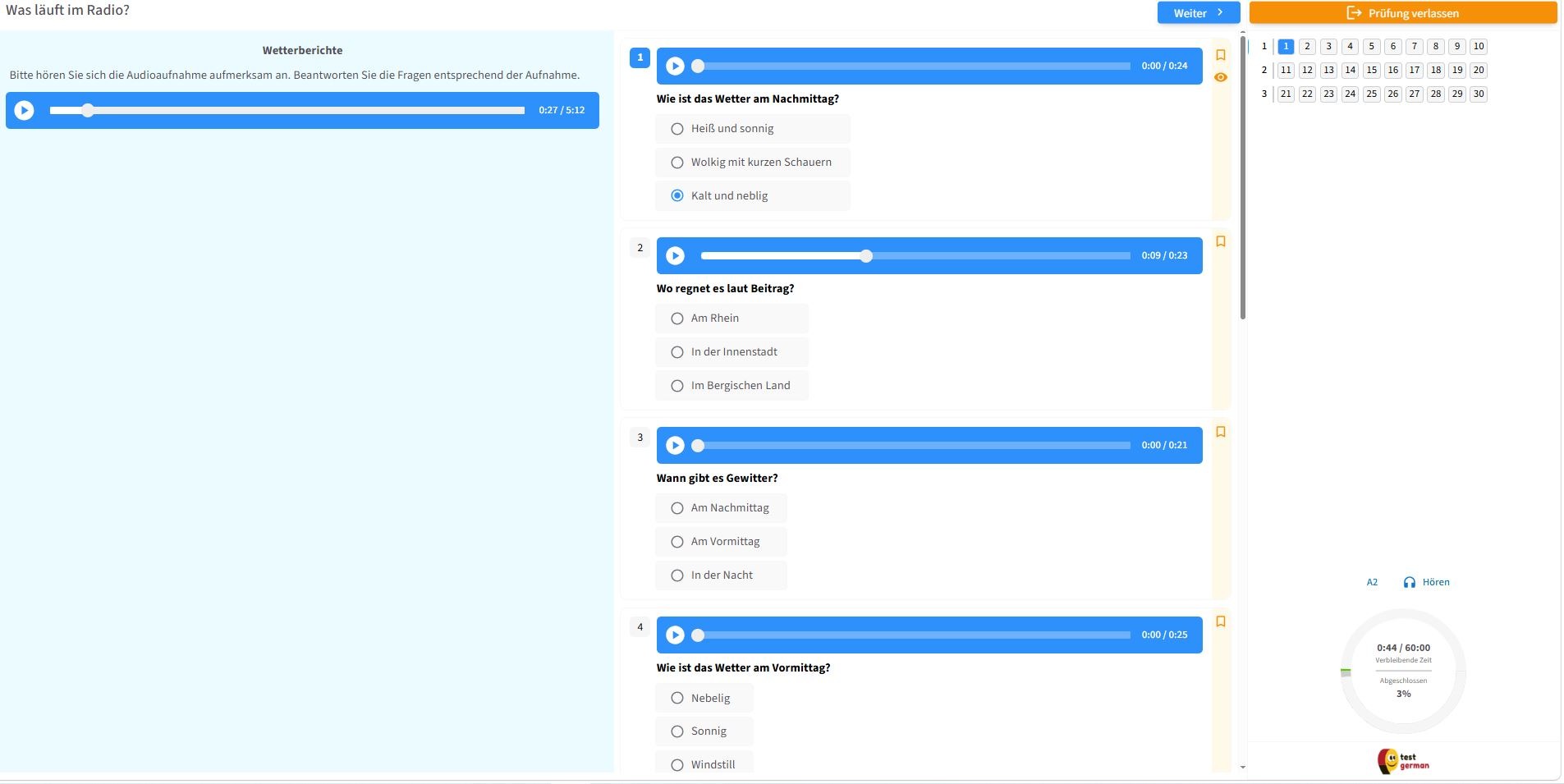
02 Skill Two · Hören

Listening / Hören

Listening Comprehension (Hörverstehen) checks whether you can understand spoken German at near-native speed. Expect radio interviews, voicemails, university lectures, and casual conversations — usually played only once or twice.

✦ what you'll practice
  • Catching gist in fast dialogues — Bahnhofsdurchsage, Wettervorhersage
  • Note-taking from a 10-minute university Vorlesung on academic topics
  • Listening for specific details: numbers, dates, prices, places
  • Distinguishing regional accents: Bavarian, Austrian, Swiss variants
  • Indirect requests like "Könnten Sie das vielleicht wiederholen?"
★ tips to improve
  • Listen to Deutschlandfunk or Tagesschau in 15-min daily sessions
  • Watch a German series first with German subtitles, then without
  • Practice shadowing — repeat sentences immediately after the speaker
  • If you're still building confidence, start with the Slow German podcast
Listening exam practice
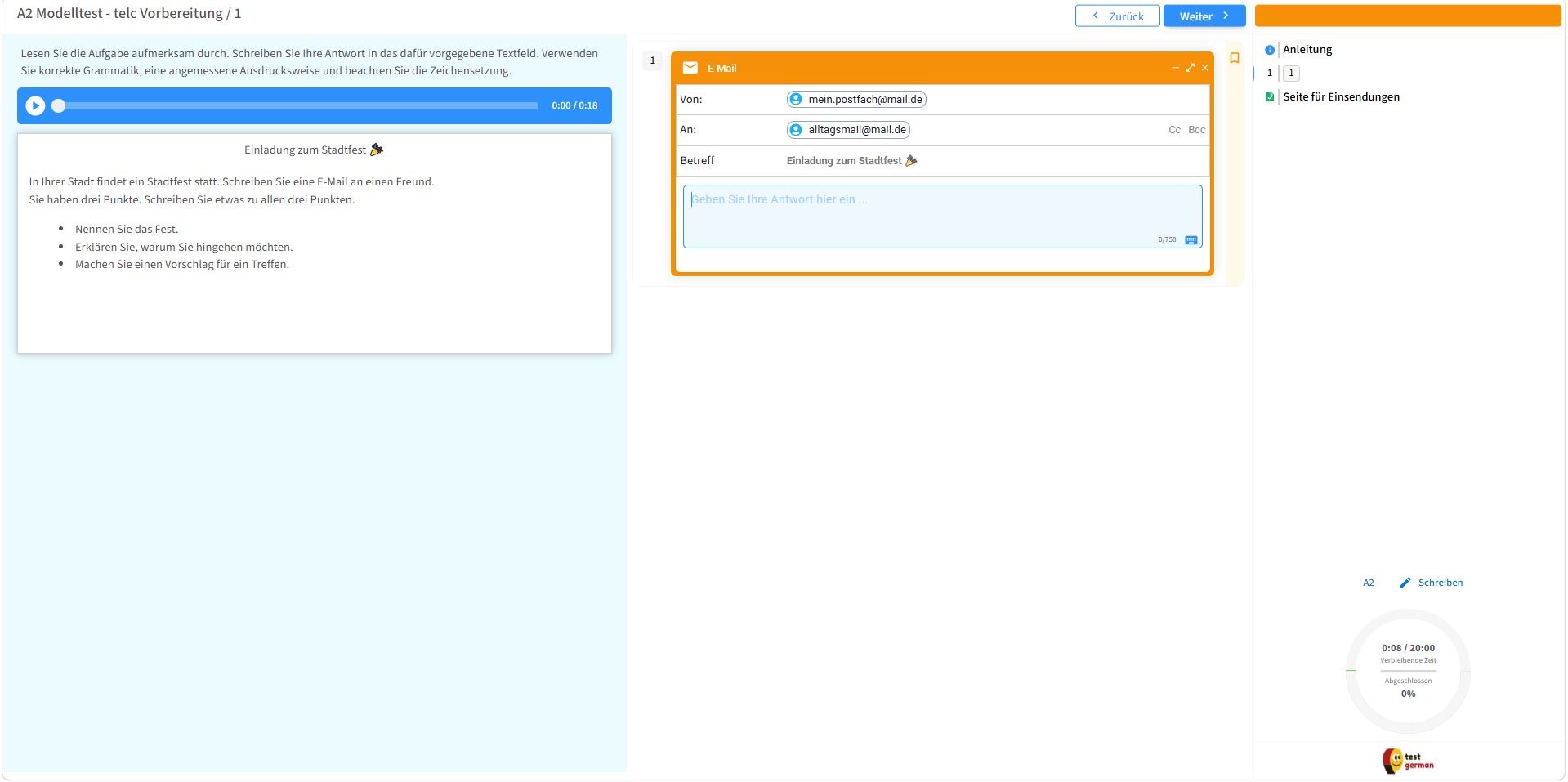
03 Skill Three · Schreiben

Writing / Schreiben

Writing (Schreiben) tests your ability to produce coherent, grammatically accurate German for specific purposes. From a 100-word email at B1 to a 350-word argumentative essay at C1, examiners score task achievement, structure, vocabulary, and grammar.

✦ what you'll practice
  • Formal letters: complaint to a Hausverwaltung, request to a Sprachschule
  • Forum posts and informal emails responding to a friend's invitation
  • Argumentative essays on Klimaschutz, Digitalisierung, Bildung
  • Describing data: Schaubild, Tabelle with academic phrasing
  • Linking with connectors: obwohl, trotzdem, infolgedessen, andererseits
★ tips to improve
  • Always plan first — 3 minutes outlining beats 10 minutes rewriting
  • Memorise 20 high-register connectors and reuse them across essays
  • Get every text corrected — repeated mistakes harden into habits
  • Vary sentence length: mix short statements with one Nebensatz
Writing exam practice
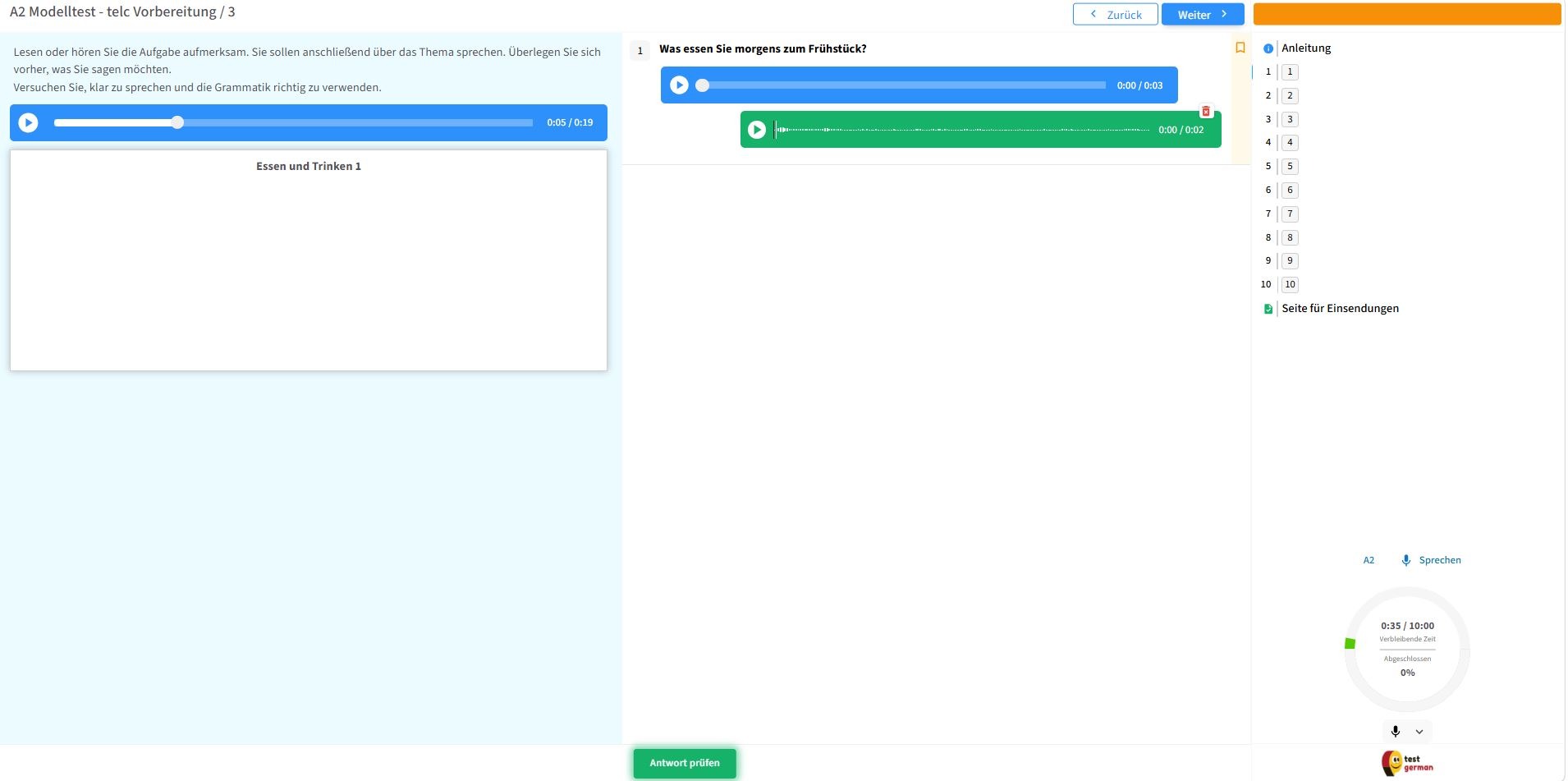
04 Skill Four · Sprechen

Speaking / Sprechen

The Speaking (Sprechen) module is usually the most feared — but it's also where preparation pays off fastest. Expect a paired interview, a short presentation on a familiar topic, and a problem-solving dialogue with another candidate or examiner.

✦ what you'll practice
  • Self-introduction monologue — "Ich heiße ... und komme aus ..."
  • Two-minute presentation: "Vor- und Nachteile des Homeoffice"
  • Negotiating a plan with a partner: "Wollen wir lieber Samstag oder Sonntag?"
  • Responding to follow-ups without long silences or English fillers
  • Tricky pronunciation: ch, ü, ö, the rolled r, final consonant devoicing
★ tips to improve
  • Record yourself daily for 60 seconds — listen back and spot one fix
  • Memorise filler phrases like "Das ist eine gute Frage" for thinking time
  • Practice with a tandem partner on Tandem or Conversation Exchange
  • Don't aim for perfect grammar in speech — aim for fluent, confident delivery
Speaking exam practice
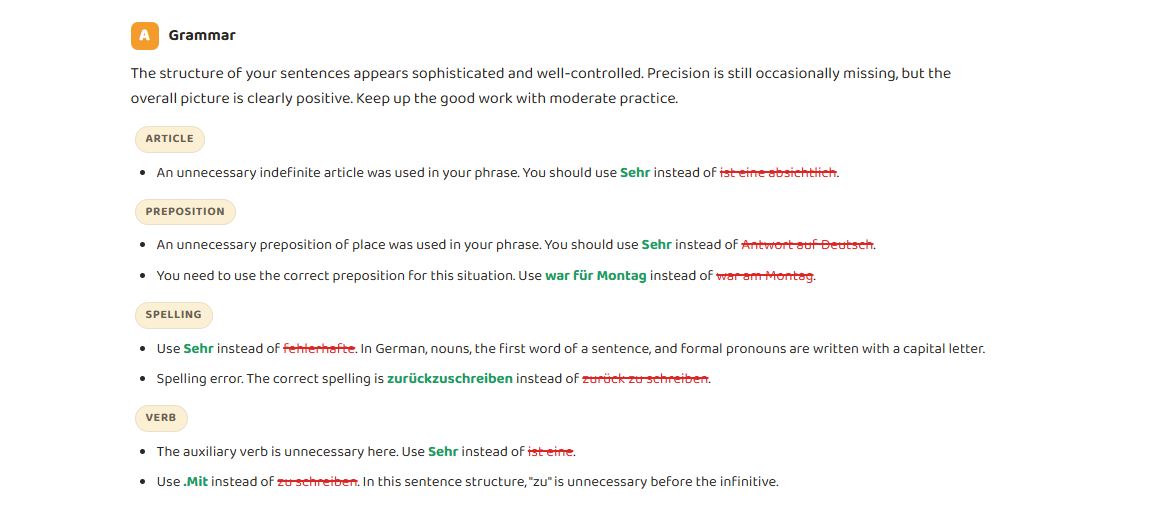
05 Skill Five · Grammar

Grammar / Grammatik

Grammar isn't a separate exam section, but it underpins every other skill. German's case system, verb position rules, and adjective endings are where most learners lose points — fix the structures below and your score in every section rises.

✦ what you'll practice
  • Four-case mastery: Nominativ, Akkusativ, Dativ, Genitiv with all article forms
  • Verb position in main and subordinate clauses (V2-Regel, dass-Sätze, weil-Sätze)
  • Adjective endings: "der gute Wein, ein guter Wein, guter Wein"
  • Konjunktiv II for polite requests: "Ich hätte gern", "wäre es möglich"
  • Passive voice and Passiversatz: "Es wird gemacht" vs "Das lässt sich machen"
★ tips to improve
  • Always learn nouns with their article — "der Tisch", never just "Tisch"
  • Memorise prepositions taking Akkusativ vs Dativ as fixed groups
  • Drill conjugation of the 50 most-used irregular verbs until automatic
  • Don't fear the Genitiv — it appears more in writing than learners expect
Grammar explanation