
Introduction
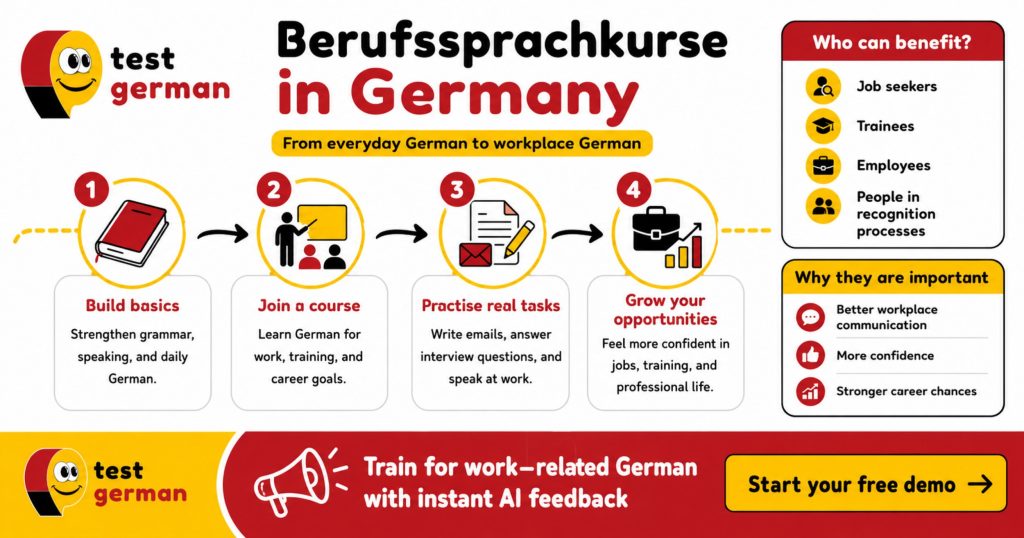
After everyday German, many learners reach a point where they need German for work. They want to write clearer emails, speak more confidently with colleagues, and understand contracts, interviews, and job tasks. This is exactly where Berufssprachkurse come in: they help people move from general German to workplace German.
These vocational language courses are funded and coordinated by the Federal Office for Migration and Refugees (BAMF) and support people who need German for jobs, training, professional recognition, or career progress. In this guide, you will learn who can join, what the courses teach, how to apply, and why they matter for your next step.
What are Berufssprachkurse in Germany?
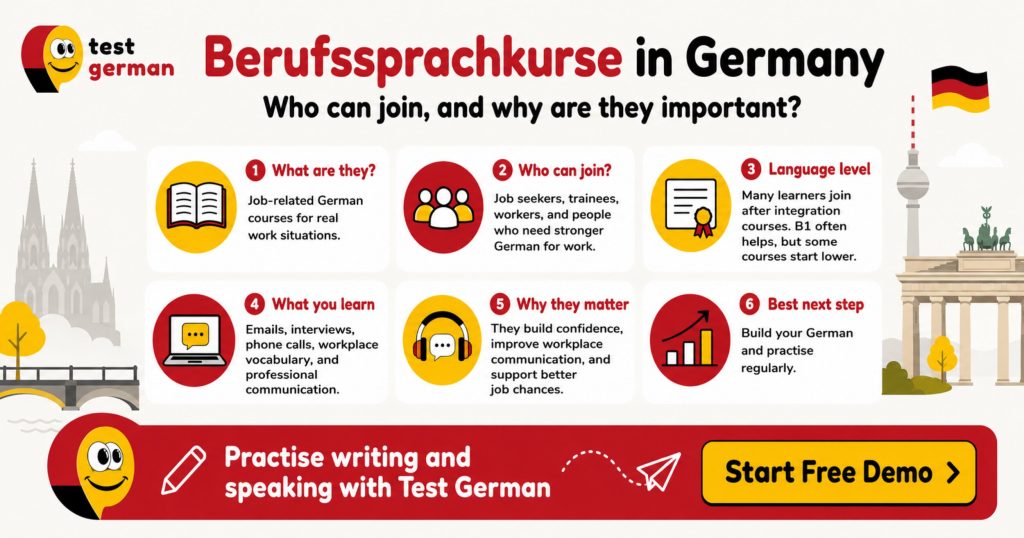
Berufssprachkurse are job-related German courses. Unlike a standard language course, they do not focus only on general grammar—instead, they prepare you for working life through practical tasks such as job interviews, workplace emails, phone calls, meetings, and professional vocabulary.
The courses run at different levels. Some help learners move from B1 to B2, while others bridge B2 to C1. There are also special courses for specific fields: healthcare workers need clinical and care vocabulary, technical workers need different terms, and office workers focus on email and meeting language. In short, these vocational courses connect language learning directly with real work situations.

Who can join Berufssprachkurse in Germany?
These courses are mainly for people with a migration background who need stronger German for work. This includes immigrants from non-EU countries and EU citizens and, in some cases, German citizens with a migration background. Usually, though, you need a reason connected to work or training.
You may be eligible if you are looking for a job, preparing for vocational training, or already employed but lacking the German needed for daily work tasks. People going through a professional recognition process — common in healthcare, nursing, and other regulated fields — can also join. So the course is not only for unemployed people; it supports employed staff, trainees, and those preparing to enter a profession.
Can I just register myself?
Not always directly. In many cases, participation requires a referral or authorization (Berechtigungsschein) from the Jobcenter, the Agentur für Arbeit, or another authorized institution. Learners who have completed an integration course may be eligible, depending on their individual situation and the requirements of the responsible authority. The clearest first step is to ask one of these offices whether you qualify and how to get your authorization.
What German level do you need?
The required level depends on the course. Many learners enter after completing an integration course, and a common requirement is German at B1 level or above.
Most Berufssprachkurse start at B1 or higher. However, some special course formats may be available for learners below B1, depending on their individual situation and local course offers. So you should not assume that every course begins at B2 — the right level depends on your current German, your goal, and your circumstances.
B1 remains a key milestone because it gives you the base for job-related German and prepares you to work toward B2. For that reason, A2 and B1 learners benefit most from building strong basics early: better grammar, clearer speaking, and stronger writing all make the next course easier.

What do you learn in Berufssprachkurse?
In these courses, you learn German for real work life. You practice writing professional emails, answering interview questions, and understanding employment contracts and workplace documents. You also build confidence speaking with colleagues, supervisors, customers, and teachers.
Common topics include:
- Job interviews
- Work emails
- Phone calls
- Workplace rules
- Employment contracts
- Application documents
- Customer communication
- Team communication
- Professional vocabulary
- Workplace problem-solving
This focus on work and career is what sets a vocational course apart from an ordinary language course, which usually centers on daily-life situations. The result is that you use German more confidently in professional settings.
Are Berufssprachkurse funded by BAMF?
Yes. Berufssprachkurse are funded and coordinated by the Federal Office for Migration and Refugees (BAMF) as part of Germany’s official language-support system. For many eligible participants, the courses are free of charge. Employed learners above a certain income may pay a small participation fee (Kostenbeteiligung), but the larger part of the cost is still covered by the state.
This funding is one reason these job-related German courses are so widely used: they make professional language training accessible without high private course fees. If you search for terms like “BAMF Berufssprachkurs,” “Berufssprachkurs B2 Germany,” or “German for work in Germany,” you will find that the official framework behind them is run through the BAMF.
Why are Berufssprachkurse important?
Berufssprachkurse matter because German for work is different from everyday German. In daily life you might ask for directions, buy food, or chat with neighbors. These skills are useful, but work life is more structured: you may need to explain a problem, write a polite email, follow detailed instructions, or speak up in a meeting.
For this reason, job-related German builds real professional confidence. It also improves your job chances, because when you communicate clearly, employers can trust your skills and you can show your professional knowledge more easily. In practice, these courses can help you find a new job—or do your current one better.
Why B1 and B2 matter for work
B1 lets you handle many everyday situations and explain simple work topics. B2 gives you far more professional power: you can explain ideas in detail, give reasons, understand more complex texts, and write clearer professional emails. This is why many learners use vocational courses as a bridge from B1 to B2.
That bridge matters, because the jump from B1 to B2 can feel hard without enough practice. The vocabulary becomes more specific, texts get longer, and speaking tasks grow more detailed. The lesson is simple: don’t wait for the course to start. Practice writing, speaking, listening, and reading every week.
How can you prepare before joining?
You can prepare in a few clear steps. First, review your B1 grammar, focusing on word order, prepositions, cases, and verb forms. Second, practice short work emails — for example, one asking for an appointment and another explaining a problem.
Third, rehearse speaking about your career goal, with simple answers about your experience, strengths, and plans. Fourth, learn vocabulary for your own field rather than random word lists: a nursing learner needs health terms, a mechanic needs tool vocabulary, and an office worker needs email and meeting language. Finally, get feedback, because it helps you spot repeated mistakes and improve faster.
How Test German can help
Before or during a Berufssprachkurs, most learners need extra practice — and that is where Test German fits in. It lets you train writing and speaking in a clear, structured way, with instant AI feedback in your own language.
This is useful because many learners know they make mistakes, but do not always understand why they happen. With targeted feedback, you can improve grammar, sentence structure, vocabulary, and task relevance and build a regular practice habit. In other words, Test German can support both your B1 preparation and your next step toward B2 German for work.
Start your free Test German demo and practice German writing and speaking with instant feedback.
Common mistakes learners make
The most common mistake is studying only general German. It is useful, but workplace German needs different phrases and structures, so practice work topics too.
A second mistake is avoiding writing. Many learners focus only on speaking, yet work often requires emails, forms, and short written messages. A third is using long sentences too early, which usually creates grammar problems—short, clear sentences are safer. A fourth is ignoring listening, even though people at work often speak quickly, so weekly listening practice pays off. The final mistake is letting your routine stop after B1; if you pause your learning, B2 only becomes harder.
Conclusion
Berufssprachkurse help learners move from everyday German to workplace German. They support job seekers, trainees, employed people, and those in professional recognition processes, and they teach practical German for interviews, emails, meetings, documents, and real work situations — all within a system funded and coordinated by the BAMF.
For many immigrants, Berufssprachkurse are an important step toward stable employment, vocational training, and long-term integration into the German labor market. So if your goal is work, training, or professional growth in Germany, start building your German early. A strong B1 base and regular practice will make your next step much easier.
FAQ: Berufssprachkurse in Germany
Are Berufssprachkurse free?
Many eligible participants can attend free of charge through BAMF funding. Employed learners above a certain income may pay a small participation fee (Kostenbeteiligung).
Can I join a Berufssprachkurs with B1 German?
Yes. Many vocational language courses start at B1 level and help learners progress toward B2. Some special formats may also be available for learners below B1, depending on their situation.
Do I need a Jobcenter referral?
In many cases, yes. Eligibility is often confirmed through the Jobcenter, the Agentur für Arbeit, the BAMF, or another authorized institution.
How long does a Berufssprachkurs take?
The duration depends on the course type and target level. Higher-level or specialized courses generally take longer than basic ones.
Who runs and funds these courses?
Berufssprachkurse are funded and coordinated by the Federal Office for Migration and Refugees (BAMF) as part of Germany’s official language-support system.
Disclaimer:
Dieser Blog dient ausschließlich zu Informations- und Aufklärungszwecken. Die Inhalte können durch andere Quellen überprüft werden. Der Autor übernimmt keine rechtliche Verantwortung für Entscheidungen, die auf Grundlage dieser Informationen getroffen werden.