
Introduction
The Goethe A1 exam for family reunion is rarely just a language test. For most people who sit in it, it is tied to a spouse, a visa appointment, and the start of a new life in Germany. That mix of paperwork and emotion is exactly why preparation should feel calm, structured, and realistic rather than rushed.
The scale of this is easy to underestimate: Germany issued more than 101,756 family reunification visas in the first eleven months of 2025 alone, and a basic German certificate is part of the process for most spouses. So if this feels like a big step, you are far from alone, and the path is well-trodden.
The good news is that A1 is a beginner level. You do not need advanced grammar or long, polished sentences. You need to understand and use simple everyday German: introduce yourself, ask basic questions, read short messages, and write a few clear lines. This guide walks you through what the exam actually requires, what the law expects, and how to prepare one skill at a time.
Is the Goethe A1 exam required for a family reunion visa?
In most cases, yes. Under German residence law, a spouse moving to join a partner in Germany must usually prove basic German at CEFR level A1 before the visa is issued, not after arrival. The requirement sits in Section 30(1) of the Residence Act (Aufenthaltsgesetz); for spouses of German citizens, the parallel rule is Section 28(1).
A few practical details matter more than most learners expect:
- Only certain certificates count. German missions generally accept proof from the Goethe-Institut, telc, or ÖSD. Certificates from unaccredited or online-only schools are typically rejected.
- Freshness matters. Although Goethe certificates do not technically expire, for a visa the certificate is usually expected to be no older than twelve months at your interview. An older certificate can trigger a refusal, so time your exam relative to your appointment.
- The exam itself is the Start Deutsch 1. The certificate most people earn for this purpose is the Goethe-Zertifikat A1: Start Deutsch 1, which the Goethe-Institut lists explicitly as proof for spousal-reunion visas.
There are exemptions. Spouses of EU Blue Card holders, researchers, and other highly qualified professionals are often released from the language requirement, as are people who clearly cannot reasonably learn the language due to illness or disability, and some applicants with strong integration indicators such as a university degree. In addition, citizens of countries like the United States, Canada, Australia, Japan, Israel, New Zealand, South Korea, and Switzerland may apply for their residence permit after entering Germany. Because rules vary by case and by consulate, always confirm your exact requirement with the responsible German embassy before you book anything.

What the A1 exam actually measures
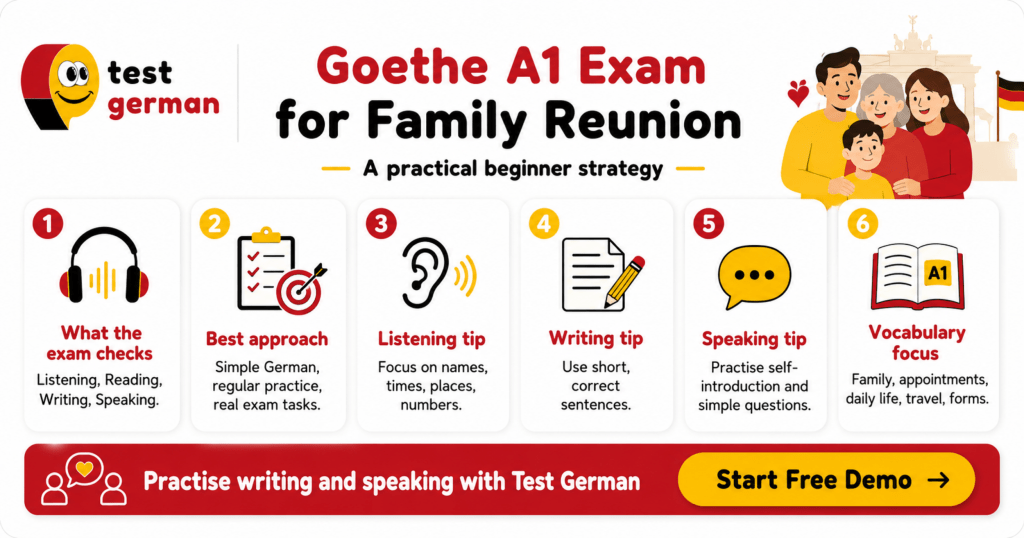
The exam checks whether you can handle simple German in everyday situations: names, numbers, times, prices, places, and short messages. You answer basic questions about yourself and ask polite questions in return.
It is worth knowing the structure, because familiarity removes a lot of fear. The Start Deutsch 1 has four sections—listening, reading, writing, and speaking (a small group oral exam). You can earn a maximum of 100 points, split as 75 for the written parts and 25 for the oral part. You pass with at least 60 points overall, provided you complete every section. There is no separate cut-off per section, so a slightly weaker module can be balanced by a stronger one.
That balance is the key takeaway: prepare all four skills, not only grammar. Clarity beats complexity here. A short, correct sentence scores better than a long, risky one.
Why does this exam feel hard for beginners?
Starting from zero, German word order feels unfamiliar, articles seem unpredictable, and pronunciation sits differently in the mouth. Exam nerves then make easy tasks feel harder, so a phrase you know perfectly at home can vanish during the speaking test. None of that means you are unprepared; it is simply how a new skill behaves under pressure.
The fix is not to study harder at random. It is to repeat the same task types until the format feels routine. When the shape of each exercise is predictable, your stress drops and your accuracy rises. A short daily routine — practice, review mistakes, repeat — beats occasional marathon sessions.
Best strategy for listening
Listening trips up many A1 learners because spoken German sounds fast at first. But A1 audio focuses on clear, everyday information, and you do not need to catch every word.
Train your ear for the details that questions actually ask about: names, dates, numbers, places, times, and prices. In practice that means deciding between things like Monday or Tuesday, 8:30 or 9:30, Berlin or Hamburg; one person or two.
Stick to realistic topics—appointments, shopping, travel, family, hobbies, and short phone messages—and use a three-pass method when you practice. First listen for the general topic, then for the key detail, then repeat the useful phrases aloud. That last pass is what builds confidence.

Best strategy for reading
A1 reading is short and practical: signs, notices, emails, forms, ads, and brief messages. The texts are small, but the details can be precise.
Read the question first, so you know what you are hunting for. Then scan for keywords rather than translating every word—if the question is about time, chase numbers and days; if it is about place, look for city names, streets, or location words. Practice the everyday topics that keep appearing: opening hours, addresses, invitations, appointments, and travel information. This habit alone saves time and lowers stress on exam day.
Best strategy for writing
Writing at A1 should be simple and correct. The most common trap is reaching for long sentences to sound advanced—which usually just multiplies grammar mistakes.
Lean on safe, reusable patterns instead:
- Ich heiße …
- Ich komme aus …
- Ich wohne in …
- Ich möchte …
- Ich brauche …
- Ich habe einen Termin.
- Können Sie mir bitte helfen?
- Vielen Dank.
Practice the message types that actually appear: an invitation, an appointment request, a short apology, and a simple question. Keep the basics tidy—German nouns are capitalized, the verb usually sits in the second position in a simple statement, and names, dates, and times should be unmistakable. Prepare a handful of dependable sentence frames in advance, then adapt them to whatever the task asks.
Best strategy for speaking
Speaking feels stressful because you have to answer in real time, but the A1 oral part is predictable. You introduce yourself, answer simple questions, ask questions, and react briefly.
Start with a solid self-introduction covering your name, country, city, languages, job, family, and hobbies. For example:
Mein Name ist Sara. Ich komme aus der Türkei. Ich wohne in Ankara. Ich spreche Türkisch und ein bisschen Deutsch. Ich bin verheiratet. Meine Hobbys sind Musik und Kochen.
Then drill the question words—Wer? Was? Wann? Wo? Wie? Wie viel? —and a set of polite questions you can lean on:
- Wie heißen Sie?
- Wo wohnen Sie?
- Haben Sie Kinder?
- Können Sie das bitte wiederholen?
- Können Sie mir bitte helfen?
Make this practice active. Do not just read the lines — say them aloud, record yourself, listen back, and improve one thing each time.
How Test German can help
Most A1 mistakes are small and repetitive: a verb in the wrong position, a missing article, a lowercase noun, or a wrong ending. Left unchecked, they harden into habits—which is why feedback matters more than raw study hours.
Test German lets you practice writing and speaking tasks in a structured, exam-style way and gives instant AI feedback in your own language. You not only see that something is wrong, but you understand why, so the same error stops recurring. That makes it a practical way to rehearse the exact task types you will face and to walk in calmer.
Start your free Test German demo and practice your A1 writing and speaking with instant feedback.
Vocabulary to learn first
Skip random word lists. Prioritize the language of real life: family, home, food, shopping, travel, appointments, numbers, time, days and months, hobbies, work, health, and personal-information forms.
Family vocabulary earns its place because you will often talk about your spouse, children, parents, and living situation. Appointment language is just as useful—Termin, Uhrzeit, Adresse, Montag, morgen, heute, bitte. And learn words inside short phrases, not in isolation: instead of memorizing “Termin” alone, learn “Ich habe einen Termin.” That way you also learn how to use it.
Common mistakes to avoid
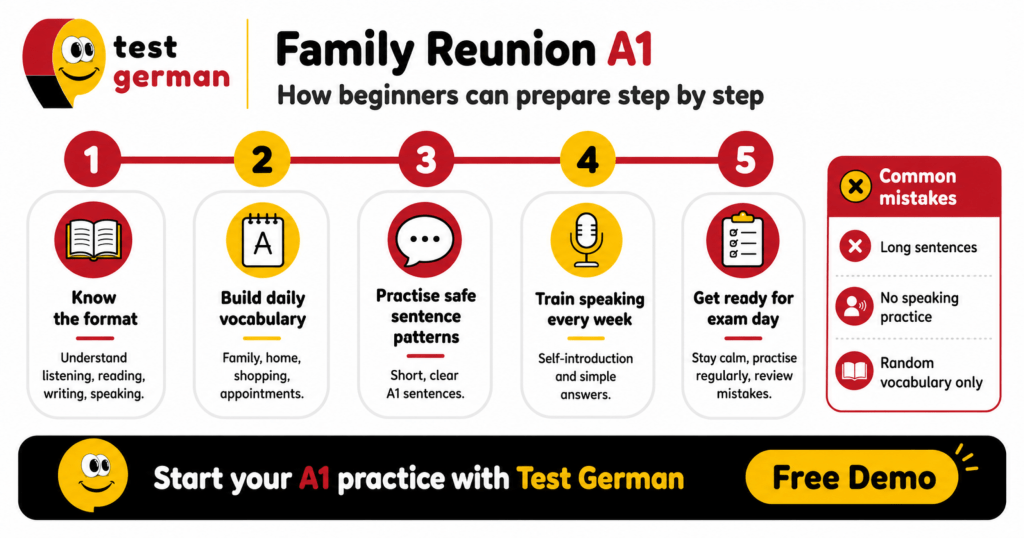
- Memorising without understanding. Scripted answers help until the examiner rephrases the question — then you freeze. Understand your sentences and practise variations.
- Neglecting listening. Many beginners pour time into grammar and writing, but listening is a full quarter of the exam and needs daily attention.
- Writing too much. A short, clear message beats a long one stuffed with errors.
- Avoiding speaking. Reading silently is not speaking practice. Say your answers out loud every day.
- Studying without feedback. Repeated mistakes become permanent without correction. Feedback exposes word order, articles, spelling, and task problems while they are still easy to fix.
A simple weekly study plan
A light, repeatable routine works better than cramming:
- Monday — Listening: short audio tasks; focus on numbers, times, places.
- Tuesday—Reading: short messages; find the key information fast.
- Wednesday — Writing: one short email or message.
- Thursday — Speaking: record your self-introduction and simple answers.
- Friday — Grammar: verb position, articles, question words.
- Saturday — Mock task: one short exam-style exercise under light time pressure.
- Sunday — Review: revisit mistakes and repeat the phrases that gave you trouble.
It looks modest, but it trains every skill on a regular cycle — which is exactly what the exam rewards.
Final preparation tips
In the last stretch, resist the urge to learn everything at once. Tighten the high-value pieces instead: rehearse your self-introduction, drill common questions, reuse your writing frames, and listen to a little simple German daily. Practicing under light time pressure now makes the real room feel calmer later.
Off the page, the logistics count too. Prepare your documents early, confirm your certificate will still be within the accepted window at your interview, sleep well the night before, and on exam day, read each instruction carefully before you start. The goal is not perfect German. It is basic, clear, and correct communication.
Conclusion
Passing the Goethe A1 exam for a family reunion is a realistic goal for an absolute beginner. You do not need advanced grammar or elaborate sentences — you need everyday German, regular practice, and a strategy that matches the real exam. Train all four skills, lean on simple sentence patterns, learn vocabulary that mirrors daily life, rehearse the actual task types, and above all, get feedback so your repeated mistakes disappear.
With a calm plan and steady practice, this exam becomes what it is meant to be: a manageable first step toward the family life waiting for you in Germany.
Disclaimer:
Dieser Blog dient ausschließlich zu Informations- und Aufklärungszwecken. Die Inhalte können durch andere Quellen überprüft werden. Der Autor übernimmt keine rechtliche Verantwortung für Entscheidungen, die auf Grundlage dieser Informationen getroffen werden.