

Introduction
The Chancenkarte is an important topic for many people in 2026. Many learners want to know one simple thing. Can I look for a job in Germany with A1 German?
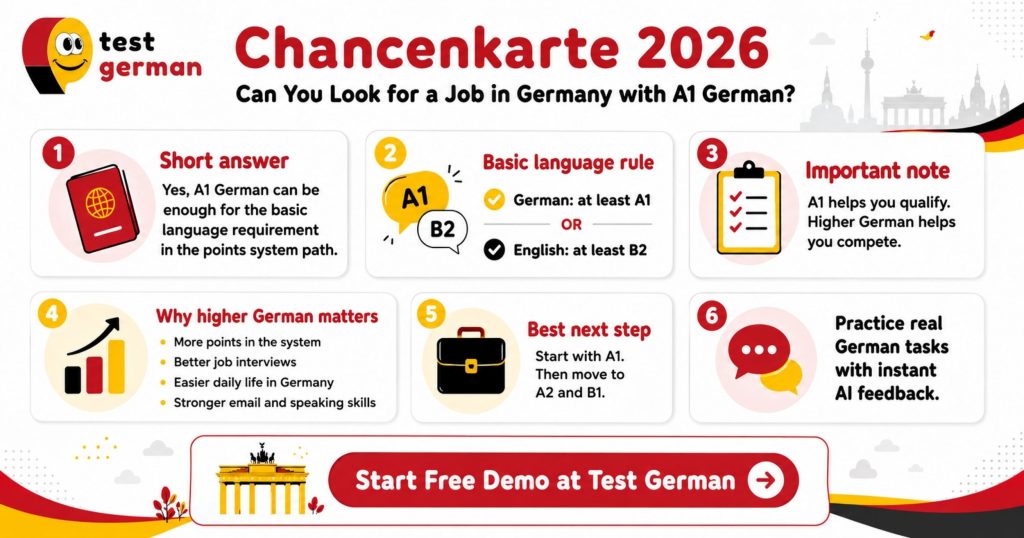
The answer can be yes. However, you must understand the rules clearly. The Opportunity Card, or Chancenkarte, helps skilled workers enter Germany for job search. For the points route, applicants need German at A1 or English at B2. They also need formal training or a university degree. In addition, they need enough money for their stay.
Therefore, A1 German can help you start. However, A1 does not make job searching easy. You can introduce yourself. You can ask simple questions. Yet, most job interviews need more German.
So, this guide explains Chancenkarte in 2026 in simple words. In addition, it shows how A1, A2, B1, and B2 can affect your job search.
What is the Chancenkarte?
“Chancenkarte” means “Opportunity Card.” It is a residence option for people from non-EU countries. It helps them come to Germany and look for work.
The card can support a job search without a fixed job contract first. The job search opportunity card normally allows a stay for up to one year. During this time, you can look for work. You can also work part-time up to 20 hours weekly. In addition, you can do short trial work.
This sounds simple. However, you still need documents. For example, you need proof of education, language skills, and money.
Because of this, Chancenkarte is not only a language topic. It is also a planning topic. You need the right certificate, the right documents, and a clear learning plan.

What does “points route” mean?
The “points route” means the points system for the Chancenkarte. It is one way to qualify for the Opportunity Card.
There are two main ways to apply. First, you can apply as a recognized skilled worker. This means Germany fully recognizes your professional qualification or university degree.
Second, you can apply through the points route. This route helps people whose qualifications are not fully recognized in Germany yet. However, they still need a formal qualification. They also need language skills and enough money for their stay.
For the points route, you usually need at least six points. You can collect points for different factors. For example, you can get points for your qualification, work experience, age, German skills, English skills, and previous connection to Germany.
This is why language matters. A1 German can help you meet the basic language requirement. However, higher German can give you more points. For example, A2 German gives more value than A1. B1 German gives even more value. B2 German gives the strongest language advantage.
Therefore, A1 German can open the first door. But A2 or B1 can make your Chancenkarte application stronger.
For this reason, Chancenkarte should not mean “learn only A1 and stop.” It should mean “start with A1, then continue to A2 and B1.” This plan gives you better chances in the points system and in a real job search.
Is A1 German enough?
For the points route, A1 German can meet the basic language requirement. English B2 can also meet it. However, you should not stop at A1. A1 means you can use very basic German. For example, you can say your name. You can ask where something is or understand short forms.
But a job search needs more. You may need to write emails. You may need to answer interview questions. Moreover, you may need to understand contracts or appointments.
Therefore, Chancenkarte should be your starting point. A2 and B1 should be your next goals.

Why higher German gives you an advantage
German level above A1 can give points in the Chancenkarte system. German A2 gives one point. German B1 gives two points. German B2 or higher gives three points.
This matters a lot. Because the points route needs at least six points. So, language can support your full application.
In addition, higher German helps in real life. For example, B1 helps you explain your experience. It also helps you speak with employers. Moreover, it helps you understand everyday work situations.
A1 can open the door. However, B1 can help you walk through it.
What can you do with A1 German?
At A1, you can handle very simple tasks. For example, you can introduce yourself. You can ask simple questions. You can understand short signs and basic forms.
This can help at the beginning. However, you should prepare realistic phrases.
Learn these examples:
- “Ich suche eine Arbeit.”
- “Ich habe Erfahrung als Verkäufer.”
- “Ich möchte in Deutschland arbeiten.”
- “Können Sie mir bitte helfen?”
- “Ich habe einen Termin.”
These sentences are simple. Yet, they can help you speak with more confidence.
In addition, you should practice listening. Many learners only study grammar. However, job search also needs listening speed. Therefore, train short dialogues every day.
Best learning path for job seekers
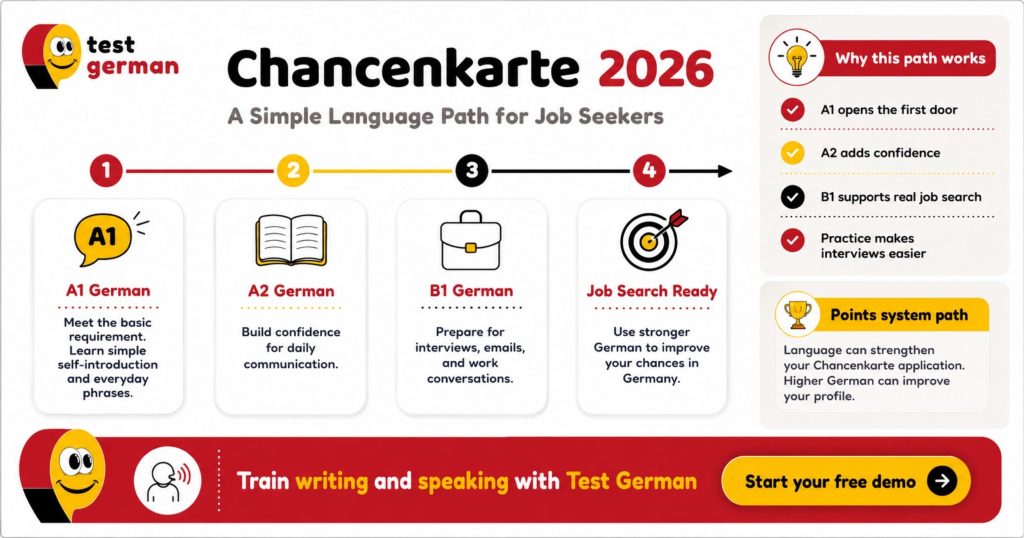
Start with A1 if you are a beginner. Then move to A2 quickly. After that, focus on B1 job language.
At A1, learn survival German. At A2, learn daily work phrases. At B1, learn interviews, emails, and workplace communication.
This path makes sense because each level adds real value. A1 helps with the application rule. A2 gives you more confidence. B1 gives you better job search power.
Test German can support this path. You can practice exam-style German tasks, get instant AI feedback, and see your mistakes clearly. The platform offers A1 to B1 practice, writing and speaking feedback, and real exam-style training.
Start your free demo. Practice German writing and speaking before your Chancenkarte journey.
If your job search plan also connects with integration or citizenship, read this related guide: Leben in Deutschland Test – Einfach vorbereiten für Integration und Einbürgerung. It explains why the Leben in Deutschland Test matters for integration and citizenship.
Common mistakes
Many learners make one big mistake. They think A1 is enough for work life. It can help with the first requirement. However, it rarely gives enough confidence for interviews.
Another mistake is ignoring writing. Job seekers often need emails. They may write to employers, agencies, or landlords. Therefore, writing practice matters.
A third mistake is learning random vocabulary. Instead, learn job words. For example, learn profession names, appointment phrases, and interview answers.
Finally, do not wait until you arrive in Germany. Start German now. Because every week of practice gives you more confidence.
Conclusion
Chancenkarte can be a real opportunity. A1 German may help you meet the basic language rule for the points route. However, better German gives you more points and better job chances.
Therefore, use A1 as your first step. Then continue with A2 and B1. In addition, practice speaking and writing often. This helps you prepare for employers, interviews, and real life in Germany.
With a clear plan, Chancenkarte becomes more than a visa topic. It becomes your first step toward work, confidence, and a better future in Germany.
For schools, training providers, and digital learning partners, Wilhelm Digital develops AI-first SaaS solutions for language learning, exams, and digital course processes. Explore Wilhelm Digital and its solution now!
Disclaimer:
Dieser Blog dient ausschließlich zu Informations- und Aufklärungszwecken. Die Inhalte können durch andere Quellen überprüft werden. Der Autor übernimmt keine rechtliche Verantwortung für Entscheidungen, die auf Grundlage dieser Informationen getroffen werden.