If your B1 exam is only one month away, you probably do not need another general explanation of German grammar. You need a plan.
A good German B1 exam preparation schedule must answer three practical questions:
- What should I practice today?
- How do I know whether I am improving?
- What should I stop spending time on?
Thirty days cannot transform an A2 learner into a strong B1 speaker through motivation alone. However, if your German is already near B1 level, four structured weeks can significantly improve exam familiarity, time management, and control of recurring mistakes.
This study plan works as a framework for Goethe B1, Telc B1, and the Deutsch-Test für Zuwanderer (DTZ). The exact task types differ, so you should always practice materials for the exam you will actually take.
The goal is not to study everything. The goal is to spend the next month on the skills that influence your result most.
Before Day 1: Confirm your exact exam
Do not begin a four-week study plan with generic B1 material if you already know your provider. Goethe, Telc, and DTZ all assess B1 ability, but they do not use identical exam structures.
For example, Goethe B1 has four modules that can be taken separately. Telc Deutsch B1 combines several sections within its written exam. DTZ is a scaled A2-B1 exam designed particularly for participants in integration courses.
Download or review the official practice material for your exact exam before starting your plan. Then use the schedule below to organize your preparation. If you are still deciding between the exams, you can find a detailed comparison in our article Goethe vs Telc vs DTZ: Which German exam should you choose?.
Week 1: Diagnose before you study more
The first week should answer one question: Where are you actually losing points? Many learners start by studying the topic they dislike most. That is not always the topic that damages their score most.
Day 1: Complete a diagnostic exam
- Take one realistic B1 mock exam or a representative set of tasks. Follow the official time limits as closely as possible.
- Do not pause to check vocabulary.
- Your purpose is measurement, not learning.
Day 2: Create an error map
- Separate your errors into categories.
- For reading, distinguish vocabulary problems from incorrect interpretation and poor time management.
- Identify missed details, distractors, numbers, and concentration problems in listening.
- For writing, analyze task completion, grammar, word order, vocabulary, and connectors.
- For speaking, review fluency, pronunciation, task relevance, and interaction.
Days 3–4: Repair your two biggest weaknesses
- Choose only two high-impact weaknesses.
- If your listening score is low because you miss numbers, practice numbers. If your writing is incomplete because you forget task points, train planning.
- Do not spend two days reviewing grammar chapters that have no connection to your actual mistakes.
Days 5–6: Repeat the weak task types
- Use new exam-style tasks so you must apply the correction in a fresh situation.
Day 7: Weekly review
- Compare your performance with Day 1 and decide what Week 2 needs to prioritize.
Week 2: Turn writing into a controlled process
Writing becomes much easier when you stop treating every task as a new creative challenge. Most B1 writing tasks require familiar communication functions: requesting information, explaining a situation, giving an opinion, apologizing, suggesting a solution, or responding to another person. Build reusable structures around those functions. If you prepare for Goethe, you can find task types and model answers in our article Goethe B1 Schreiben PDF: E-Mail, Opinion, and Task Answer Guide.
Start every task with content points
- Before writing, identify exactly what the task asks you to communicate.
- Then decide the register.
- Are you writing to a friend, a course provider, an employer, an organization, or another public contact?
- This decision influences greetings, requests, and closing phrases.
Build a connector system
- At B1 level, you should be comfortable with connectors such as weil, deshalb, trotzdem, obwohl, außerdem, and wenn.
- However, using many connectors is not automatically better.
- Your goal is to connect ideas correctly and naturally.
Correct writing systematically
- After each practice task, separate corrections by category.
- Do not simply rewrite the teacher’s or system’s improved version.
- Understand why the original sentence was weaker.
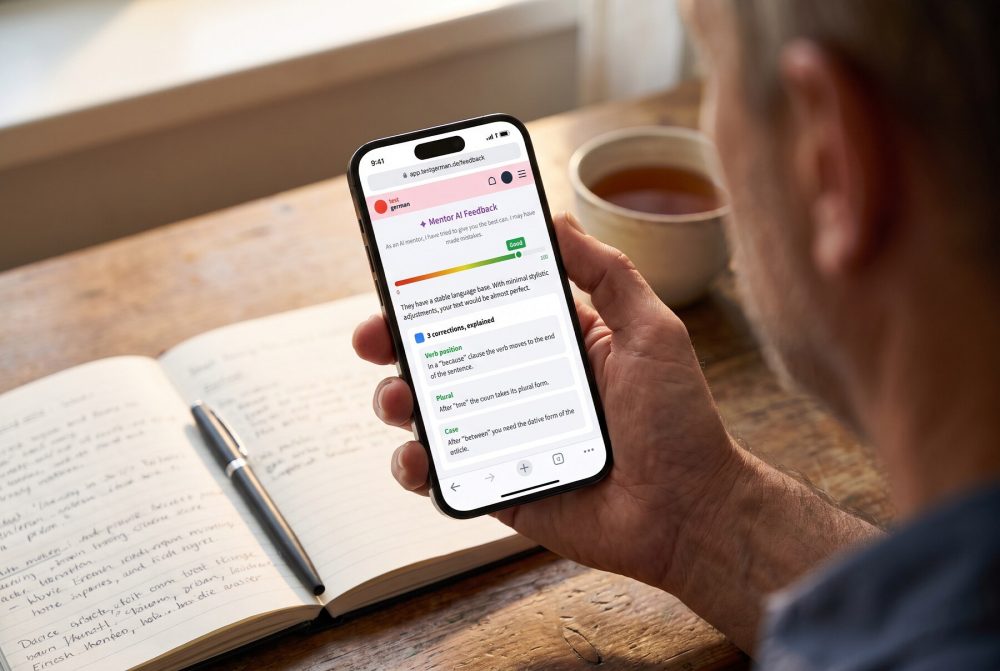
Test German’s writing feedback supports this type of targeted review by analyzing areas including grammar, word order, connectors, vocabulary, and task relevance.
Week 3: Make speaking more automatic
Speaking often feels harder because candidates cannot edit a sentence after saying it. For this reason, Week 3 should focus on automatic communication rather than memorizing complete speeches. For typical tasks and answer templates, you can find more information in our article B1 Sprechen Prüfung Guide: Telc B1, Goethe B1 & DTZ Speaking.
Practice speaking every day
- Ten focused minutes every day is more useful than one two-hour speaking session.
- Choose an everyday topic and speak for one or two minutes.
- Record yourself.
- Then listen once for communication and once for language.
- Ask whether the listener can follow your ideas easily.
Train useful speaking functions
- At the B1 level, you need language for expressing opinions, agreeing, disagreeing, suggesting, asking follow-up questions, and giving reasons.
- Practice these functions with different topics.
- For example, the same phrase for making a suggestion can work when planning a trip, party, course activity, or weekend meeting.
Do not memorize complete answers
- Memorized answers become dangerous when the exam task is slightly different.
- Instead, memorize flexible structures.
- This gives you support without making your response sound disconnected from the actual task.
Week 4: Stop studying like a student and start practicing like a candidate
The final week should increasingly resemble the real exam. At this stage, another twenty pages of grammar notes are less valuable than controlled exam simulation.
Complete at least two full mock sessions
- Use the correct timing and task order for your exam.
- Remove distractions.
- Keep your phone away.
- Do not use a dictionary unless your official exam rules allow it.
- Goethe itself advises candidates to set a clock according to the official time limit and simulate the exam.
Review every mock exam
- A mock exam has limited value if you only read the score.
- Ask why every wrong answer happened.
- Then decide whether the problem requires language study or exam strategy.
Reduce new material during the final days
- The final two or three days should strengthen existing knowledge rather than introduce large new grammar topics.
- Review useful structures, common mistakes, connectors, and task strategies.
- Sleep and concentration also affect exam performance.
A practical 30-day distribution
A balanced month might devote roughly one quarter of study time to reading and listening, another quarter to writing, another quarter to speaking, and the remaining time to grammar repair, mock exams, and error review. However, equal distribution is not automatically efficient.
If listening is already strong and writing is clearly below B1, your plan should reflect that difference. Personalized preparation is more valuable than a perfectly symmetrical calendar.
Goethe B1: What should you emphasize?
Goethe candidates should become comfortable with each independent module and its timing. The B1 exam currently includes 65 minutes for reading, 40 minutes for listening, 60 minutes for writing, and approximately 15 minutes for speaking. Because the modules are clearly separated, you can measure each skill individually during preparation. Use this advantage. Track reading, listening, writing, and speaking separately instead of recording only one overall practice score. You can find a detailed format comparison in our article Goethe B1 vs Telc B1: Format, Timing and Task Differences.
Telc B1: What should you emphasize?
Telc candidates should become comfortable moving through the written exam without losing concentration. The exam includes reading, language elements, listening, and a 30-minute writing section before the oral exam. Sprachbausteine deserve specific practice because they form a clear part of the Telc format. Writing speed also deserves attention because 30 minutes passes quickly when you need time for planning and correction. You can find more information about the exam in our article What is the Telc B1 Prüfung?.
DTZ: What should you emphasize?
DTZ candidates should focus strongly on practical communication. g.a.s.t. describes the exam as a standardized A2-B1 test designed for migrants and used as the final language exam in integration courses.
The writing section includes one semi-formal or formal message, with two task options available. Candidates receive four content points and have 30 minutes. That means task completion and everyday communication deserve very high priority. You can find more information in our article DTZ Prüfung Guide: Deutsch-Test für Zuwanderer A2–B1 Preparation.
Why a structured learning environment helps
Thirty-day preparation becomes difficult when tasks, corrections, mock exams, and progress data live in different places. A structured learning environment can reduce this fragmentation.
This approach also appears in institutional language learning. For example, our sister company Tuees combines study plans, self-study phases, digital exercises, and progress analysis within one learning workflow.
Individual exam preparation benefits from the same principle: know what you are doing today, why you are doing it, and what the result tells you to do tomorrow.
Conclusion
Effective German B1 exam preparation does not mean studying every German topic before exam day. It means using limited time intelligently.
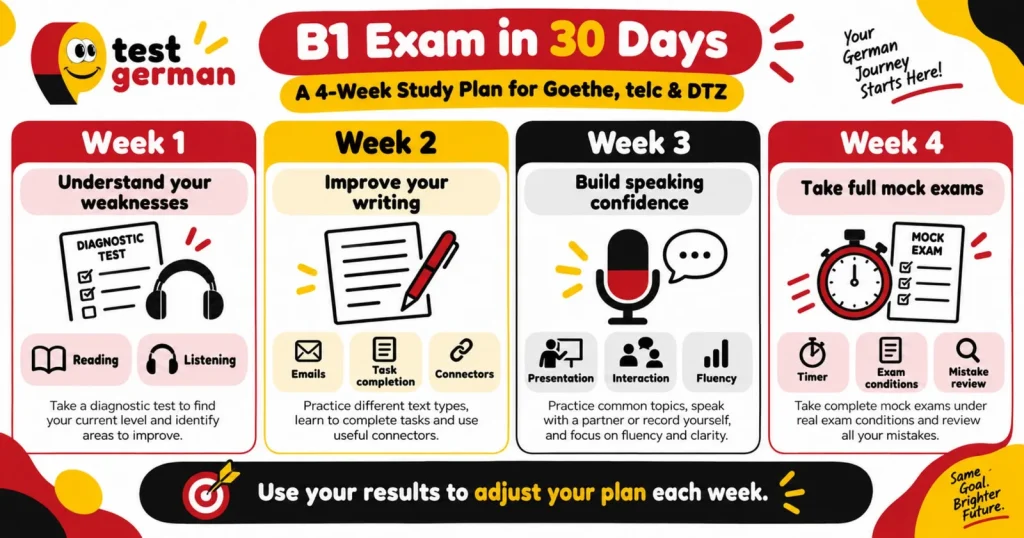
Week 1 should diagnose your weaknesses. Week 2 should make writing more controlled. Week 3 should make speaking more automatic. Week 4 should move you into realistic exam conditions.
Throughout the month, reading and listening should remain active parts of the routine, particularly when your diagnostic results show weaknesses in those areas.
Most importantly, your plan should respond to evidence. If your mock exams show the same problem repeatedly, change your study behavior rather than simply doing more exercises.
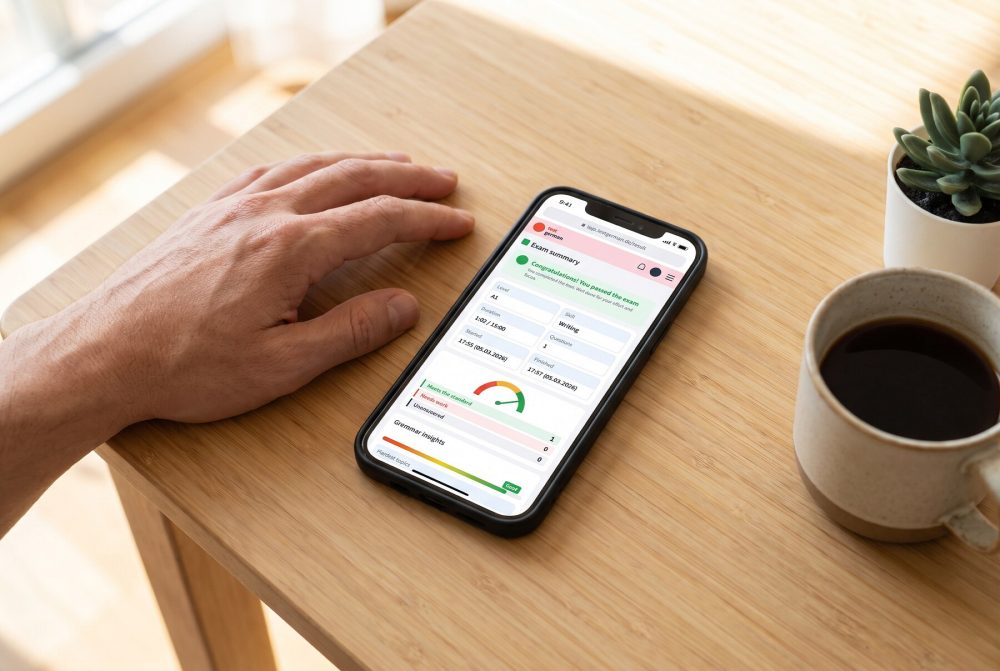
Test German combines exam-style tasks, simulations, AI feedback, and progress tracking for learners preparing for Goethe, Telc, and DTZ. Start with a realistic B1 practice test, identify your weak areas, and build your next 30 days around the results.
FAQs About the 30-Day B1 Study Plan
Yes, if your German is already close to B1 and your main goal is exam preparation. Four weeks can improve format familiarity, timing, writing organization, and speaking confidence. However, one month is not a realistic guarantee of moving an entire CEFR level from weak A2 to secure B1.
Consistency matters more than one universal number. A focused 60–90 minutes on most days can be productive when it includes active practice and review. Learners with more time can study longer, but each session should still have a clear purpose.
Review grammar that appears in your real mistakes. B1 candidates usually benefit from control of verb position, cases, common prepositions, subordinate clauses, adjective endings, and verb forms. However, exam preparation should not become an endless grammar course.
There is no magic number. Quality matters more than volume. Complete enough simulations to become comfortable with timing, but analyze each one carefully. Two fully reviewed mock exams can teach more than five rushed ones.
There is no single universal skill because exam providers assess several competencies. Your biggest improvement usually comes from identifying which tested skill currently creates the largest gap in your own performance.