Last updated: August 27, 2026 · Sources checked: EU AI Act (Article 4), OECD/European Commission AI Literacy Framework, peer-reviewed L2 writing research (2025)
Introduction
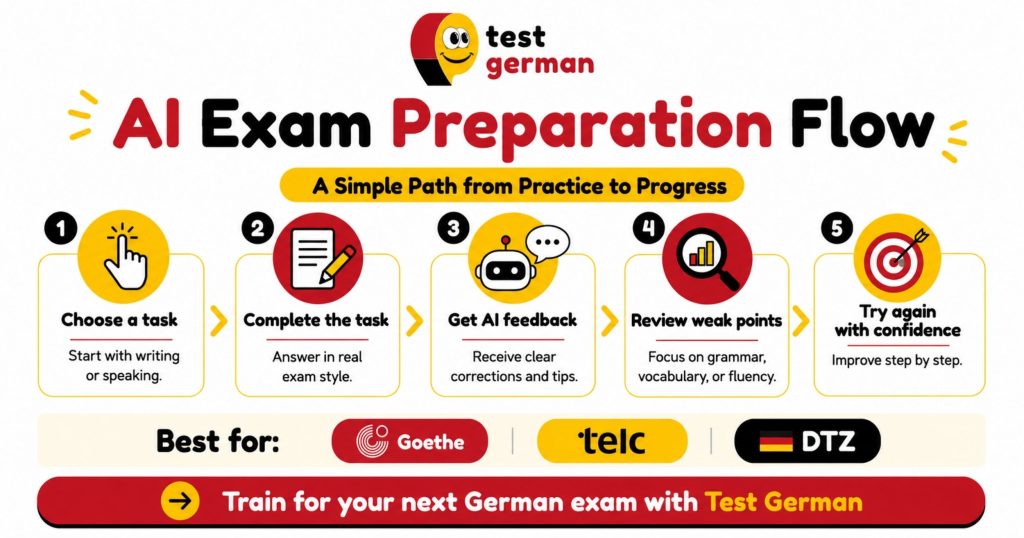
AI German exam preparation is changing how learners study. In the past, many learners waited several days for writing correction. Speaking feedback was even harder to find. Today, AI can review practice within seconds. This guide looks specifically at AI German exam preparation — what it can realistically do for your Goethe, telc, or DTZ result, and where it still falls short.
However, fast feedback does not automatically create progress. AI can support learning, but it cannot take the exam for you. It can also give weak or incorrect advice when the system does not understand the task or scoring criteria.
This guide explains where AI adds real value. It also explains the limits, recent research, 2026 education developments, and a safe practice method. The goal is not to replace teachers. The goal is to use technology for more focused and frequent practice.
Can AI help you pass?
Yes, AI can improve your preparation when it gives exam-focused feedback and you act on it. It can help you practise more often, find repeated errors, and understand corrections. However, it cannot guarantee a pass. You still need official materials, realistic timing, independent language skills, and human support when necessary.
What AI does well
Area | Useful AI support | Learner benefit |
Writing | Grammar, word order, spelling, vocabulary, structure, task relevance | Fast correction and clear revision targets |
Speaking | Pronunciation signals, fluency, sentence suggestions, task response | More frequent speaking practice |
Planning | Study schedules and weak-area tracking | Clear next steps |
Practice generation | Similar prompts and follow-up exercises | More repetition without copying one task |
Language access | Feedback in the learner’s first language | Better understanding of complex corrections |

AI writing correction: More than red marks
A simple grammar checker finds surface errors. An exam-focused system should do more. It should ask whether you answered every task point. It should check tone, structure, connection, vocabulary, and grammar.
For example, a learner may write accurate sentences but forget the request. A normal correction tool may say the text is correct. However, an examiner can still reduce the score because the task is incomplete.
The best feedback explains the reason. It should show the original phrase, a correction, and a short rule. Then the learner should create a new sentence with the same rule.
AI speaking correction: Useful but more complex
Speaking includes several areas. Pronunciation matters, but so do fluency, relevance, vocabulary, grammar, and interaction. Therefore, one pronunciation score cannot describe full exam performance.
AI can help learners record answers repeatedly. It can identify pauses, unclear sounds, or weak structure. It can also suggest better phrases. This repeated private practice can reduce fear.
However, real speaking exams include another person. You must listen, react, interrupt politely, negotiate, and manage unexpected questions. Human partner practice remains important.
What recent research suggests
Recent language-learning research shows promising results for AI-supported feedback. Studies report that immediate feedback can support revision, engagement, and self-directed practice. Research also suggests that AI can identify many language problems accurately.
At the same time, the quality is not equal across every scoring area. A 2025 study on ChatGPT-4 and second-language writing found strong accuracy in many areas. However, feedback specificity varied. The system could also misclassify some grammar and vocabulary errors.
Another important finding concerns prompt and system design. Research published in late 2025 found that domain-specific prompts can change the quality of automated corrective feedback. Therefore, an exam-trained system can be more useful than a general chatbot prompt.
The expert conclusion is balanced: AI can support learning, especially for frequent formative feedback. However, learners need clear criteria, human oversight, and active revision.

The difference between correction and learning
Only correction | Real learning |
The tool changes the sentence. | You understand why the sentence changes. |
You copy the model answer. | You create a new sentence yourself. |
You feel finished after one task. | You repeat the weak skill in another task. |
You focus on the score. | You focus on the error pattern. |
You depend on help while writing. | You first write independently under time pressure. |
A safe 6-step AI practice method
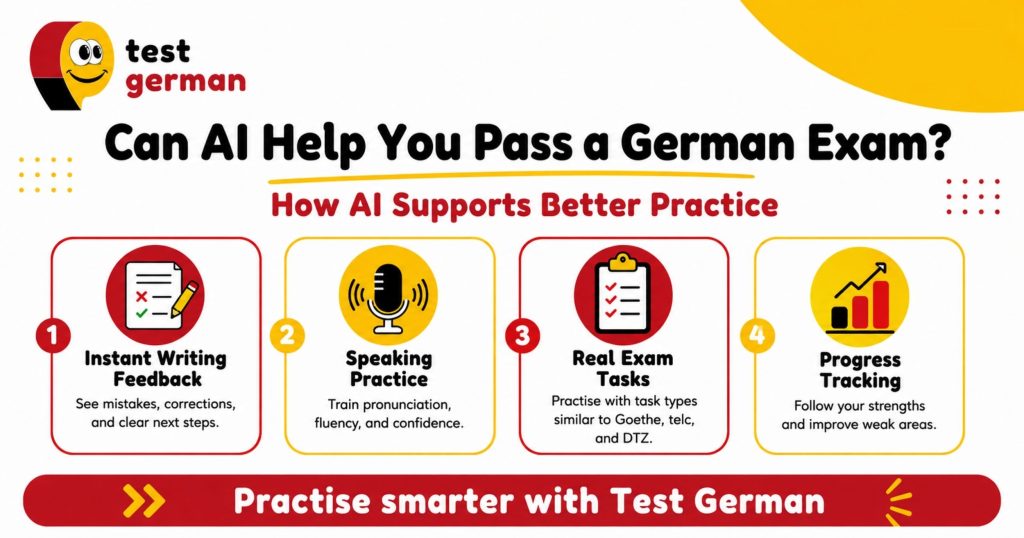
- Choose an official or realistic exam-style task.
- Complete it independently under a timer.
- Request feedback based on the correct exam criteria.
- Study the three most important errors, not every small detail at once.
- Rewrite the answer without copying the full model.
- Complete a related task later and check whether the error returns.
Where AI can fail
Incorrect corrections
AI can misunderstand context or suggest language that is too advanced. Compare important points with reliable grammar sources or a teacher.
Generic scoring
A general chatbot may not know the exact exam rubric. Use a system designed for the exam format.
False confidence
A high practice score does not guarantee exam performance. Use timed simulations and official model tests.
Overdependence
If AI writes your answer, your own skill does not improve. Always produce the first version independently.
Privacy concerns
Do not upload sensitive personal documents or unnecessary private information. Check the platform’s privacy rules.
Loss of human interaction
AI cannot fully replace a real speaking partner, teacher, or examiner-style conversation.
AI in Education: Important 2026 Developments
AI literacy has become a major education topic in Europe. Article 4 of the EU AI Act requires providers and deployers to support sufficient AI literacy for people who use AI systems on their behalf. The rule started applying on 2 February 2025, and the European Commission published further guidance and resources during 2026.
In June 2026, the European Education Area also presented an AI literacy framework for schools. The wider message is relevant for adult learners too: people should understand what AI can do, where it can fail, and how to check its output.
UNESCO guidance also supports a human-centred approach. It highlights opportunity, but it also stresses privacy, inclusion, age-appropriate use, and responsible design. Therefore, good AI exam preparation should build learner independence, not replace it.
How Test German uses AI for exam preparation
Test German focuses on Goethe, telc, and DTZ exam practice. Learners can train writing and speaking in exam-style formats. They can also receive immediate feedback in their own language.
The feedback covers grammar, sentence structure, word order, spelling, vocabulary, and task relevance. In addition, the platform connects practice with progress tracking. This helps learners see repeated weaknesses over time.
The strongest use is not “AI writes for me.” Instead, the learner writes or speaks first. The system then explains the result and gives a clear next step. This keeps the learner active.
A 4-week AI-supported study plan
Week | Goal | AI-supported work | Human or official check |
1 | Find baseline | Complete one writing and one speaking task | Use an official model test to confirm format |
2 | Fix two repeated errors | Practise targeted tasks and rewrite answers | Ask a teacher or partner about unclear feedback |
3 | Build exam speed | Use timers and full task sets | Practise speaking with a real partner |
4 | Stabilise performance | Complete two mock exams and review trends | Check final strategy with official instructions |
How to judge an AI feedback tool
- Does it use the correct exam format and level?
- Does it explain why an answer is weak?
- Does it check task completion, not only grammar?
- Can it show repeated patterns across tasks?
- Does it protect personal data and explain its policies?
- Does it encourage independent practice and rewriting?
- Can you understand the feedback in your own language?
Realistic results you can expect
AI can help you increase practice frequency. It can shorten the time between writing and correction. It can also make hidden patterns visible. For example, you may discover that most lost points come from missing task details, not grammar.
You can also expect better self-awareness. After several tasks, you may know your common word-order errors, weak speaking openings, or repeated vocabulary. This knowledge makes study more focused.
However, no responsible platform should promise guaranteed exam success. Results depend on your starting level, study time, practice quality, health, stress, and exam-day performance.
Conclusion
AI German Exam preparation can add real value. It gives fast feedback, supports repeated practice, and helps learners understand their weak areas. Recent research supports this potential, especially when feedback follows clear criteria.
Still, AI has limits. It can make mistakes, give generic advice, or create dependence. Therefore, use official materials, practise independently, and include human interaction.
Use AI as a mentor, not as a substitute for your own German. Write first. Speak first. Study the feedback. Then repeat the task. This active process gives you the best chance to enter the exam with real skill and confidence.
FAQ
Can AI guarantee that I pass a German exam?
No. AI can speed up feedback and help you practise more often, but exam success also depends on your starting level, study time, and performance under real exam-day conditions — factors no feedback tool controls. Research on AI-supported writing feedback shows real benefits for revision and engagement, but not a guaranteed outcome. Treat AI as a practice accelerator, not a substitute for official preparation.
Is AI writing correction accurate?
It can be quite accurate, especially for surface-level issues like grammar, spelling, and word order. However, peer-reviewed research on ChatGPT-4 found that accuracy varies by category — it sometimes misclassifies errors in grammar and vocabulary, and feedback specificity is not always consistent. For exam preparation, use a system trained on the exact exam format, and double-check important corrections against an official source or teacher.
Can AI improve German pronunciation?
Yes, to a meaningful extent — AI can flag unclear sounds, pacing, and pronunciation patterns after repeated recordings, which is hard to get without a teacher present. However, a German speaking exam also scores fluency, task relevance, grammar, and real-time interaction with another person, so pronunciation feedback alone does not prepare you for the full speaking module. Combine AI practice with at least some sessions with a real speaking partner.
Should I use a general chatbot or an exam platform?
An exam-focused platform is usually the better choice for exam prep, because it can apply the actual task types and scoring criteria of Goethe, telc, or DTZ. Research comparing prompt designs shows that generic chatbot prompts produce less accurate, less targeted feedback than prompts built with domain-specific exam knowledge. A general chatbot can still help with casual practice, but expect more generic, less rubric-aligned corrections.
Does AI replace a German teacher?
No. AI is well-suited to fast, frequent, low-stakes feedback between lessons, but teachers bring judgement that automated tools still lack — reading nuance, adjusting strategy to your specific weaknesses, and running real interactive speaking practice. The most effective approach combines both: AI for daily practice volume, a teacher or partner for depth and real conversation.
How often should I use AI feedback?
Use it after completing a focused, timed task — not while writing, and not for every unfinished sentence. Rewriting your answer using the feedback matters more than the number of times you submit text, since real learning comes from applying a correction yourself, not just reading it. A good rhythm is one focused task followed by one careful revision, repeated regularly rather than rushed in bulk.
Disclaimer:
Dieser Blog dient ausschließlich zu Informations- und Aufklärungszwecken. Die Inhalte können durch andere Quellen überprüft werden. Der Autor übernimmt keine rechtliche Verantwortung für Entscheidungen, die auf Grundlage dieser Informationen getroffen werden.