Last updated: August 27, 2026 · Fact-checked against official sources (Goethe-Institut, telc GmbH, BAMF)
Introduction
Goethe vs telc is a common comparison. However, many learners in Germany must also consider the DTZ. These exams can prove German ability, but they do not serve every goal in the same way. This guide answers the Goethe vs telc B1 question directly, and also explains where DTZ B1 fits in, so you do not book the wrong German exam.
The right exam depends on the authority, employer, university, or programme that needs your certificate. It also depends on your level, location, preferred format, and personal strengths. Therefore, do not choose only because one exam looks easier.
This guide compares Goethe, telc, and DTZ in clear B1 English. It explains purpose, format, recognition, scoring, flexibility, and 2026 developments. It also gives a decision process you can use before booking.
Quick answer
- Choose Goethe when you want a widely known international certificate and modular B1 testing.
- Choose telc when your institution accepts a specific telc exam or you need a specialised format.
- Choose DTZ when you take an integration course and need an A2-B1 result for that context.
- Always ask the receiving institution for written confirmation before paying.
The most important rule: Recognition comes first
A certificate has value only when the receiving organisation accepts it. Different goals can have different rules. For example, a university may require a higher academic exam. An integration course may use DTZ. An employer may accept several B1 certificates.
Ask a precise question: “Do you accept Goethe-Zertifikat B1, telc Deutsch B1, or DTZ B1 for this purpose?” Keep the written answer. This step protects you from choosing the wrong exam.
Rules can also change. Local authorities may request additional documents. Therefore, use current official information, not only advice from social media groups.
What is the Goethe-Zertifikat B1?
The Goethe-Zertifikat B1 confirms independent language use at CEFR B1. It includes reading, listening, writing, and speaking. Each module receives its own score.
A module passes from 60 points. Because the modules are separate, candidates can often book or repeat individual modules. This flexibility can help learners with one weaker skill.
Goethe also offers official model tests and online practice. The certificate is widely known internationally. However, fees and dates depend on the country and exam centre.

What is telc Deutsch B1?
telc offers many language exams. The exact exam name matters. telc Deutsch B1 is a general B1 exam with written and oral parts. telc also offers A2-B1, work-related, school, medical, and university-focused exams.
The general telc Deutsch B1 exam includes reading, language elements, listening, writing, and speaking. The oral exam usually has two candidates and preparation time.
In 2026, telc continues its digital development. DIGItelc 2.0 started a gradual rollout in March and April 2026. However, availability depends on the examination centre and exam type.
What is the DTZ?
DTZ means Deutsch-Test für Zuwanderer. It is connected to integration courses in Germany. The exam measures performance across A2 and B1.
The written test lasts 100 minutes and includes listening, reading, and a short letter. The oral test lasts about 15 minutes. Candidates introduce themselves, discuss familiar topics, and plan something together.
For overall B1, speaking must reach B1. In addition, writing or listening and reading must reach B1. Therefore, DTZ uses a special result logic that differs from a simple one-level exam.
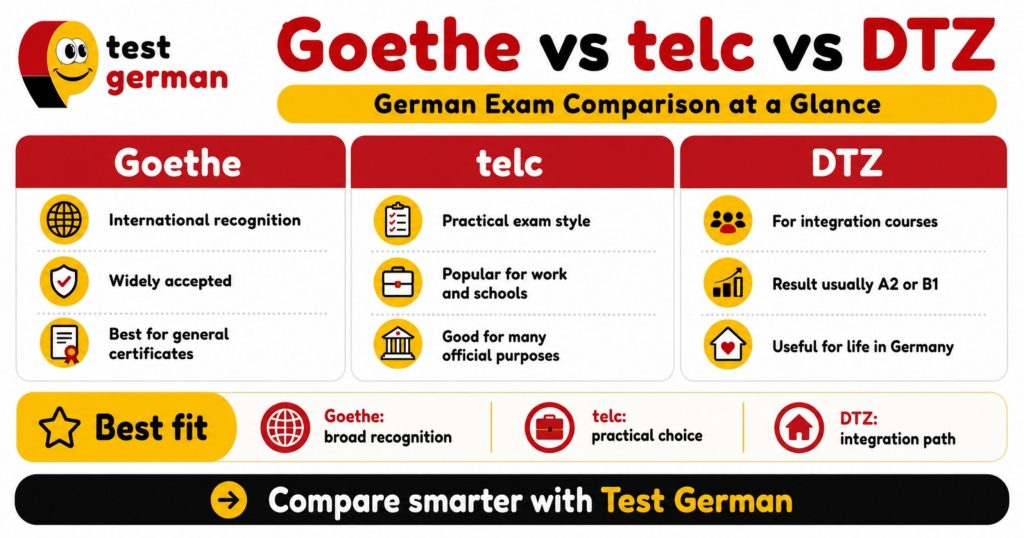
Goethe vs telc vs DTZ: Main comparison
Question | Goethe B1 | telc Deutsch B1 | DTZ |
Main purpose | General, international B1 proof | General or specialised proof | Integration course language test |
Levels | One level: B1 | Usually one level for telc B1 | Scaled A2-B1 |
Skills | Four separate modules | Written and oral examination | Written and oral examination |
Modular flexibility | Yes at B1 | General telc B1 is not normally a partial exam | No modular certificate structure |
Writing | Separate 60-minute module | One writing task within written exam | Short letter or email |
Speaking | Usually pair format | Usually pair format with preparation | Interaction and joint planning |
Digital development | Digital practice and centre-specific delivery | DIGItelc 2.0 rollout in 2026 | Centre and integration-course procedures |
Best fit | Flexible, internationally familiar option | Specific telc need or format | Integration-course learners |
Goethe or telc — which German B1 exam feels easier?
No exam is easier for everyone. Your skill profile matters. A learner who likes separate modules may prefer Goethe. A learner who knows telc task types from a course may prefer telc. An integration course learner may find DTZ topics familiar.
Format familiarity often feels like “difficulty”. When you practise the exact task types, the exam becomes more predictable. Therefore, compare official model tests before deciding.
Do not choose an exam only because someone online passed it. Their goal, level, and strengths may differ from yours.

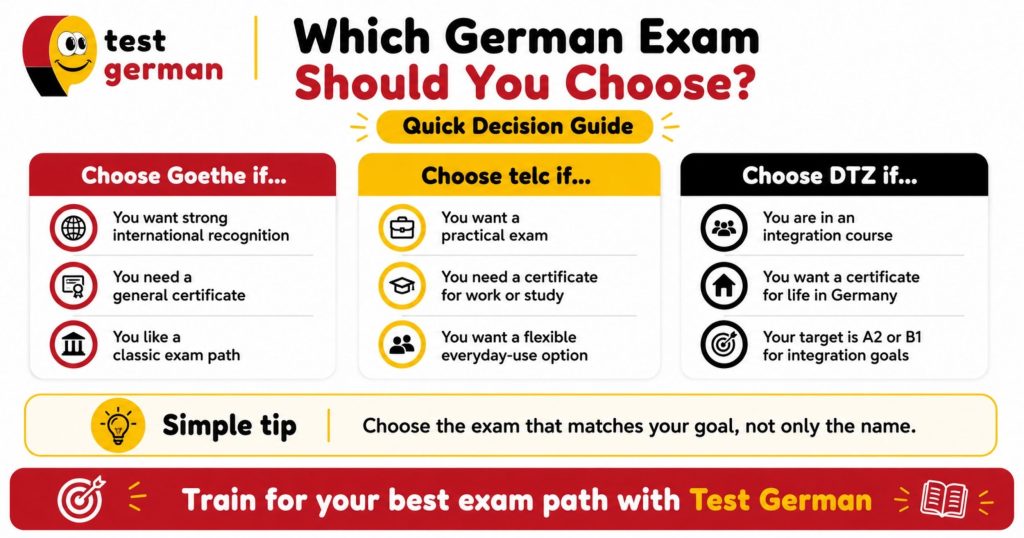
Choose based on your goal: Goethe B1 vs telc B1 vs DTZ
Goal | First option to investigate | Important check |
Integration course completion | DTZ | Ask your course provider about registration and result use. |
General international B1 certificate | Goethe or telc | Confirm acceptance in the target country or institution. |
Employer requirement | Goethe or a suitable telc exam | Ask for the exact certificate name and level. |
Permanent residence or citizenship | Accepted B1 proof may vary | Check the current authority requirements. |
University study | Usually a higher academic exam | Ask the university; B1 is often not enough. |
Professional field | Specialised telc may be relevant | Check whether general B1 or professional German is required. |
Choose based on your strengths
- One weak module: Goethe B1 may offer useful modular flexibility.
- Strong course preparation for one format: follow the format you know well, if accepted.
- Strong speaking and practical daily German: DTZ may fit integration goals.
- Need a specialised certificate: explore the exact telc exam for your field.
- Need global familiarity: compare Goethe and telc recognition for your destination.
Goethe vs telc vs DTZ: cost, dates, and location
Exam prices change by centre and country. GoGoethe B1 fees in Germany typically range from about €165 to €230 for the full exam, depending on the centre and whether you are enrolled in a preparation course; retaking a single module usually costs less than the full exam (often €70–90). Fees also vary by country — for example, Switzerland and Austria charge more. telc and DTZ fees follow a similar centre-dependent pattern. Always check the current price on the exam centre’s own page before booking.
Availability can matter more than a small price difference. A centre near you may offer one exam every month and another only twice a year. Therefore, compare travel, waiting time, result time, and retake options.
Before booking, ask about identification, cancellation rules, special needs, result delivery, and retake procedures.
Goethe vs telc vs DTZ decision checklist
- Which organisation needs my certificate?
- Which exact exam names does it accept?
- What minimum level do I need?
- Do I want or need separate modules?
- Which official model test fits my strengths?
- Which exam centre has suitable dates and costs?
- What happens if I fail one part?
Common comparison mistakes
- Comparing only the brand name and not the exact exam.
- Assuming every B1 certificate works for every purpose.
- Choosing from price alone.
- Ignoring the speaking format.
- Using old information about recognition or digital delivery.
- Booking before checking official requirements.
How to prepare after you choose
Download the official model test for your exact exam. Complete it once without time pressure. Learn the task types and scoring areas.
Next, create a skill plan. Practice reading and listening for speed. Practice writing and speaking with feedback. In addition, complete full simulations under realistic timing.
Test German supports Goethe, telc, and DTZ practice in real exam-style formats. You can receive instant writing and speaking feedback in your own language. Therefore, you can prepare for the exam you actually chose.
Conclusion
The Goethe vs telc vs DTZ decision should start with your goal. Recognition comes before personal preference. After that, compare format, flexibility, dates, cost, and your skill profile.
Goethe B1 offers separate modules and wide international familiarity. telc offers many general and specialised exams, with ongoing digital development in 2026. DTZ serves integration course learners and reports A2 or B1 performance.
Confirm the accepted certificate in writing. Then train with the exact task types. A clear decision and realistic practice can save time, money, and stress.
Sources
FAQ
Is Goethe better than telc?
Neither exam is universally “better” — Goethe and telc B1 test the same CEFR level and are both widely accepted. The real difference is structure:
Goethe B1 lets you book and retake individual modules, which helps if one skill (e.g. Writing) is weaker than the others, while general telc Deutsch B1 is usually taken as one combined exam. Choose based on which certificate your target institution accepts and which format suits your strengths.
Is DTZ the same as telc A2-B1?
No. The DTZ is developed for BAMF-run integration courses and is normally only available to integration-course participants at the end of their course. telc Deutsch A2·B1 is a separate, general-purpose telc exam anyone can book independently. Both are scaled A2-B1 exams with a similar format, but they serve different administrative purposes — DTZ results feed directly into integration-course and residency processes, while telc A2·B1 does not.
Can I use DTZ for citizenship or residence?
Often yes — a B1 result on the DTZ is commonly used as proof of language ability for permanent residence (Niederlassungserlaubnis) and citizenship applications in Germany. However, exact requirements can change and vary by case, so always confirm the current rules with your local Ausländerbehörde or the BAMF directly before relying on it.
Can I repeat only one Goethe B1 module?
Yes, in most cases. Because the Goethe-Zertifikat B1 scores Reading, Listening, Writing, and Speaking as four independent modules, a passed module stays valid and only the failed one needs to be retaken — you do not have to sit the whole exam again. Availability depends on your local exam centre’s scheduling, so confirm retake dates and fees with them directly (source: Goethe-Institut Durchführungsbestimmungen).
Is telc B1 available digitally?
Yes, at many centres. telc rolled out its new digital exam system, DIGItelc 2.0, in stages during March and April 2026, and telc has also been moving certificates and result sheets to a fully digital format since early 2026. However, not every examination centre has adopted digital delivery yet, and the Speaking module is still conducted in person, so check the format (digital, hybrid, or paper-based) with your specific centre before booking (source: telc.net).
Which exam has the easiest writing section?
There is no single “easiest” writing section — difficulty depends on your own strengths. Goethe B1’s Writing module is a standalone 60-minute task scored separately (so a weak Writing score cannot be offset by other modules), while telc and DTZ writing tasks are shorter and embedded within a combined written exam. If structured, focused writing practice suits you, Goethe’s separate module may feel more manageable; if you prefer one combined session, telc or DTZ may fit better. Compare the official model tests for each exam before deciding.
Disclaimer:
Dieser Blog dient ausschließlich zu Informations- und Aufklärungszwecken. Die Inhalte können durch andere Quellen überprüft werden. Der Autor übernimmt keine rechtliche Verantwortung für Entscheidungen, die auf Grundlage dieser Informationen getroffen werden.