

At the DTZ, roughly 16 minutes of speaking decide whether your certificate says B1 or A2. You can answer 40 of the 45 Hören and Lesen items correctly and still walk away with A2, because speaking has a special status in the Deutsch-Test für Zuwanderer that no other section has.
That rule shapes everything else, which skill you protect, which one you build second, and what you do with the eight weeks you have left. So let’s start there, then work through the exam in the order you’ll actually meet it on the day.
The rule that decides your certificate
The DTZ is a scaled A2–B1 exam. It doesn’t hand out a pass or a fail; it reports where your German landed. Results are calculated in three separate areas: Hören + Lesen combined, Schreiben, and Sprechen.
For B1 overall, you need B1 in Sprechen plus B1 in at least one of the other two areas — either Hören + Lesen or Schreiben.
Two things follow. First, Sprechen is a gate rather than one skill among four: B1 in both written areas with A2 in speaking still produces an A2 certificate. Second, you don’t need B1 everywhere. One of the two written areas is enough, which turns your preparation into a real strategic choice most learners never make deliberately.
The same logic applies one level down. An A2 certificate requires at least A2 in Sprechen plus at least A2 in one of the other two areas. And there’s a hard floor worth knowing: if your Sprechen result comes in below A2, you receive no certificate at all, whatever your written results look like.
What the DTZ is and what it isn’t
The Deutsch-Test für Zuwanderer is the language exam that closes the integration course. Since January 2023 it has been administered by g.a.s.t. (Gesellschaft für Akademische Studienvorbereitung und Testentwicklung), and it’s built on the Rahmencurriculum für Integrationskurse — the framework written for integration courses, which is why every task traces back to a situation somebody actually has in Germany. A letter from the Jobcenter. A recorded message from a doctor’s surgery. A notice about who cleans the stairwell. A disagreement about which Saturday works for both of you.
That design explains a frustration a lot of learners feel. You can work through B1 grammar tables for three months and still lose points, because the exam isn’t checking whether you know the Konjunktiv II — it’s checking whether you can reschedule an appointment in writing without leaving out the reason.
One clarification that comes up constantly: the DTZ is not the Leben in Deutschland test. Both sit at the end of the integration course and you need both for the Zertifikat Integrationskurs, but they measure different things. LiD covers society, law and civic life. The DTZ covers language.

Structure and timing
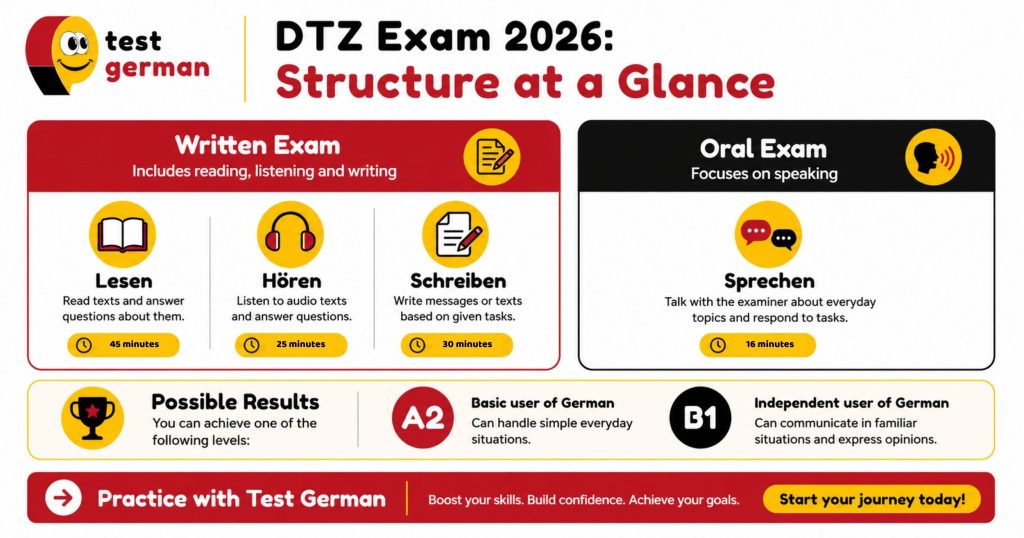
Part | Time | Format |
Hören | approx. 25 min | 4 sections, 20 items |
Lesen | 45 min | 5 sections, 25 items |
Schreiben | 30 min | one letter or email (task A or B) |
Written total | 100 min | no breaks |
Sprechen | approx. 16 min | 3 parts, normally a pair exam |
Now the rule that catches people out. Each section may only be worked on during its own allotted time. You cannot finish Lesen early and start Schreiben. Since 2023 the exam booklet carries STOP markers at the end of Hören and Lesen, and turning ahead to a section whose time has not yet begun is not permitted. Time you lose — leaving the room, arriving at your seat late — cannot be made up.
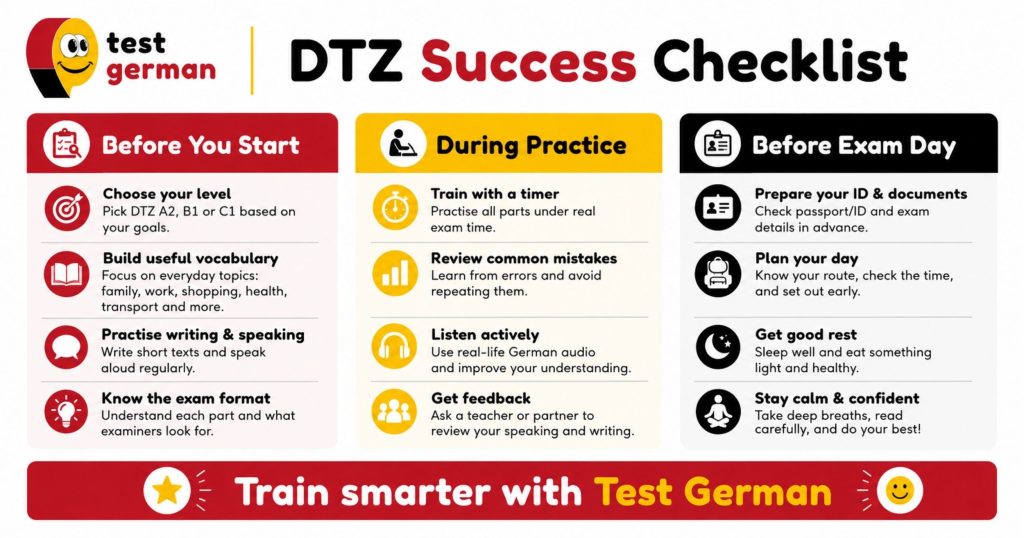
Practise under exactly these limits. Forty-five minutes for Lesen means forty-five, including marking your answers on the Antwortbogen.
Hören and Lesen: your target is 33
These two sections are calculated together as one result area. Each correct answer is worth one point, and the totals are fixed:
- Hören: 20 items — telephone and public announcements, short media pieces, everyday conversations, opinions on a topic
- Lesen: 25 items — directories, small ads, press texts and formal notices, information leaflets, and a gap-fill letter
- 45 items in total
Correct answers | Result |
33–45 | B1 |
20–32 | A2 |
0–19 | below A2 |
Thirty-three out of forty-five. That number is the single most useful thing to carry into your preparation, because it turns every mock test into a measurement instead of a feeling. If Hören + Lesen is the area you’re relying on for your second B1, you know exactly where you stand after every practice set.
In Hören, work out the frame before you chase detail: who is speaking, where they are, what they want. With the frame in place an unknown word costs you nothing. Most of these tasks are built around corrections — a time is named and then changed, a price is quoted and then discounted — and the answer is nearly always the later version.
In Lesen, the most common wrong answer in the whole exam is the option that repeats a word from the text. Find the sentence that carries the meaning, not the sentence that shares vocabulary. Read the question first, scan for names, dates, prices, places and negations, then read the surrounding sentence properly.
When you review, sort mistakes by cause rather than by task number. Missed a number. Missed a negation. Took information that was corrected later. Matched a word instead of a meaning. Four categories cover most errors, and each has a different fix.
Sprechen: 16 minutes, three parts, no preparation time
Two licensed examiners run the exam. One takes the role of conversation partner; the other observes and grades and will say almost nothing. Don’t read the silent one’s face — that isn’t what it’s for. You’ll normally be paired with a second candidate, and while about 20 minutes are booked for the pair, roughly 16 of those are the conversation itself; the remainder is the examiners conferring after you leave.
There is no preparation time. You walk in and begin.

Teil 1 — Über sich sprechen (approx. 4 minutes)
Both candidates get the same prompt sheet, with the headings Name, Geburtsort, Wohnort, Arbeit/Beruf, Familie, Sprachen. You introduce yourselves one after the other, and each of you then answers one follow-up question from the examiner.
Don’t memorise a monologue. The follow-up exists precisely to see what happens when your script runs out. Prepare flexible material instead and let the examiner steer.
- „Ich heiße … und komme ursprünglich aus …”
- „Geboren bin ich in …, seit drei Jahren wohne ich in Düren.”
- „Zurzeit besuche ich einen Integrationskurs. Davor habe ich als Krankenpflegerin gearbeitet.”
- „Neben meiner Muttersprache spreche ich noch Englisch und ein bisschen Deutsch.”
- „Das mache ich meistens am Wochenende, weil ich dann Zeit für meine Familie habe.”
Teil 2 — Über Erfahrungen sprechen (approx. 6 minutes)
Each of you receives a photo, and the two photos are different. You describe yours, then the examiner asks follow-up questions about your own experience with the topic. The examiners work from two prepared question sets, one pitched at A2 and one at B1, and they choose based on what you give them — which means the level of the conversation partly follows the level of your first answer.
The trap here is pure description. „Ich sehe eine Frau. Sie ist in einer Küche. Sie kocht.” is A2 output on a task that can carry B1. What lifts it is the connection to something real.
- „Auf meinem Foto sehe ich …, und das erinnert mich an …”
- „Als ich neu in Deutschland war, hatte ich eine ähnliche Situation.”
- „In meinem Heimatland läuft das etwas anders: …”
- „Meiner Erfahrung nach ist es besser, wenn …”
- „Das ist eine interessante Frage. Ich glaube, dass …”
Teil 3 — Gemeinsam etwas planen (approx. 6 minutes)
You and your partner receive the same sheet and plan something together: a class outing, a party, or a trip. The bullet points on the sheet are there to help—where to go, what to see, whether to stay overnight, food, and who should come.
This part is about interaction, and it carries the heaviest single weight on the rating sheet. Presenting a complete, polished plan of your own scores worse than making a rough suggestion, listening, disagreeing politely, and arriving at a compromise together.
- „Wir könnten am Samstagvormittag losfahren.”
- „Das finde ich eine gute Idee.”
- „Samstag passt mir leider nicht. Wie wäre es mit Sonntag?”
- „Was meinst du dazu?”
- „Sollen wir etwas zu essen mitnehmen?”
- „Gut, dann machen wir das so.”
Agree with your partner beforehand whether you’ll use du or Sie, and then stay consistent.
How the 100 points break down
The Sprechen rating sheet is public, and knowing it changes where you spend your practice time. Task completion is graded separately for each of the five sub-tasks; the four language criteria are judged across the whole conversation.
Criterion | Max points |
Task completion — Teil 1A | 5 |
Task completion — Teil 1B | 5 |
Task completion — Teil 2A | 10 |
Task completion — Teil 2B | 10 |
Task completion — Teil 3 | 20 |
Pronunciation / intonation | 10 |
Fluency | 10 |
Accuracy | 15 |
Vocabulary | 15 |
Total | 100 |
75 points and above is B1. 35 to 74.5 is A2, and a Sprechen result below 34.5 means no certificate is issued at all, whatever your written results look like.
One thing to understand about that table: the examiners are not adding up points while you talk. For each criterion they tick a descriptor — B1 well met, B1 met, A2 well met, A2 met, A1, or 0 — and the points are the conversion applied afterwards. The two examiners grade independently and the final result is the average of their two sheets. That’s why “say more correct sentences” is the wrong goal and “show the behaviour the descriptor names” is the right one: in Teil 3, the B1 descriptor asks you to start a conversation and keep it going, make suggestions and react to your partner’s.
Look at that table again. Teil 3 alone is worth 20 points from six minutes of planning — as much as both halves of Teil 2 combined. Accuracy, the thing most learners lose sleep over, is 15. If your practice time is limited, spend it on the planning conversation.
Schreiben: two tasks, one choice, four Leitpunkte
You have 30 minutes and you’ll be given two tasks, A and B. Choose one, write one text, and tick on the answer sheet which one you chose. Each task comes with four Leitpunkte that need to be addressed — and addressed as a coherent message, not as four disconnected answers stapled together.
The rating sheet has four criteria, each worth up to 5 points: Inhalt, Kommunikative Gestaltung, Korrektheit, Wortschatz. Twenty points in total, and 15 is the B1 threshold (7–14 is A2).
This is where the four Leitpunkte stop being generic advice and become arithmetic:
Inhalt | What it means |
5 | All four Leitpunkte covered precisely |
4 | All four covered but the reader has to fill gaps — or three covered well |
3 | Three covered with gaps — or two covered well |
2 | Two covered with gaps — or one covered well |
1 | Only one covered |
0 | None covered, or the situation has been misunderstood |
And one rule that ends the exam for you: if the text has little or no connection to the prompt, all four criteria are scored 0. Read the situation twice before you start writing.
Here too the rating is descriptor-based rather than a running tally — the points above are how those descriptors convert.
A structure that survives time pressure:
- Greeting — decide Sie or du before you write a word, then don’t drift.
- Reason for writing — first sentence, no throat-clearing.
- Content — the four Leitpunkte, one or two sentences each, in a sensible order.
- Closing — say what should happen next, then sign off.
Task: You have an appointment at the Jobcenter and cannot attend. Mention the original appointment, explain why you can’t come, suggest a new date, ask for confirmation.
Sehr geehrte Frau Becker,
ich habe am 12. September um 10 Uhr einen Termin bei Ihnen im Jobcenter. Leider kann ich diesen Termin nicht wahrnehmen, weil mein Sohn an diesem Tag einen Arzttermin hat.
Könnten wir den Termin auf den 14. oder 15. September verschieben? Über eine kurze Bestätigung würde ich mich sehr freuen.
Mit freundlichen Grüßen
Amina Said
Four points, four moves, nothing wasted. Two formatting details worth copying: ich stays lowercase after the comma in the salutation, and there is no comma after Mit freundlichen Grüßen. Small signals, but they read as someone who has written German letters before.
Before you hand it in, count the Leitpunkte against the task. Ten seconds, and it’s the cheapest points you will ever save.
The exam-day rules nobody writes about
Several things changed when g.a.s.t. took over administration, and they cost people points every session:
- Only a non-erasable ballpoint pen, black or blue. No pencils.
- To correct a marked answer, fill in the wrong box completely, then tick the right one.
- The answer sheets are personalized. You sign to confirm your details are correct—tell the invigilator immediately if anything is wrong.
- Hören and Lesen share one answer sheet. The Schreibbogen is separate and is only handed out when Schreiben begins.
- There is one Schreibbogen, front and back. No extra sheets are issued. Plan your length accordingly.
- In Schreiben, only what’s on the Schreibbogen counts. Notes in the booklet are ignored.
- Tick A or B on the answer sheet to show which task you wrote.
- No dictionaries, no phones, no leaving your seat. One drink, your ID, your pen, your papers.
Choosing your second strong area
Sprechen is compulsory. The second B1 is a choice, and it should be an honest one rather than a hopeful one.
Build Schreiben if your time is short. It’s one task with a predictable shape and a narrow set of criteria, and structured practice with real feedback moves it quickly. Structured writing practice with targeted feedback tends to move this area faster than unfocused repetition.
Build Hören + Lesen if your mock scores already sit near 30 out of 45 and you live in German day to day — you work in it, your children bring notes home, you read your post instead of photographing it for a translation app. That exposure has been feeding this area already, and it responds to volume.
Take one realistic timed mock test, look at the number, and decide from that. Not from how the sections feel.
An eight-week plan
Weeks | Focus | What that looks like |
1–2 | Format | One free g.a.s.t. Übungssatz, untimed. Stop after each section and work out what the task actually wanted. |
3–4 | Routine | Hören and Lesen daily. Two written tasks and two speaking sessions per week. Start the error log. |
5–6 | Weak spot | Read the log and repeat the category of mistake, not the same exercise. Teil 3 twice a week. |
7 | Pressure | Two full mock exams under the real time limits, answer sheet included. |
8 | Consolidation | Review phrases, redo old mistakes, sleep properly. No new grammar. |
g.a.s.t. publishes two complete Übungssätze free of charge, with audio. Use them as your week-one and week-seven benchmarks rather than burning them early.
The error log is the part people skip and the part that works. Three columns: what I answered, what was correct, why I went wrong. After twenty rows the pattern is usually both obvious and fixable.
If you don’t reach B1
The DTZ isn’t modular in the way exams with carry-over modules are. Repeating means sitting the written and oral parts again; a strong Sprechen result from a previous attempt doesn’t transfer.
If you took part in an integration course, ask your course provider about the registration procedure, whether you qualify for a funded repeat, and what the current fee is. Ask early — the answer affects which exam date makes sense.
An A2 result isn’t nothing, either. It’s a real certificate, and for learners coming out of an Alphabetisierungskurs it’s often exactly the right outcome for that year.
Where TestGerman fits
Knowing the format is the easy half. The hard part is working out why your letter scored 12 instead of 15, or which of the five speaking criteria is holding you at A2—because nobody in the exam room tells you, and the certificate arrives weeks later with a level and no explanation.
TestGerman scores your written and spoken answers against those same criteria—Inhalt, kommunikative Gestaltung, Korrektheit, Wortschatz for writing; task completion, pronunciation, fluency, accuracy, and vocabulary for speaking—and explains every deduction in one of 18 languages. „Korrektheit: 3/5″ becomes a sentence in your own language telling you which error pattern cost the points, with a worked example you can reuse in the next letter.
You can run full DTZ-format mock exams under the real time limits, and practise Teil 3 without having to find a speaking partner at nine in the evening. Try the free demo and see what your current answer actually scores.
Our German-language guide DTZ Training Sprechen Teil 1–3 goes deeper on the speaking parts.
FAQ
Is the DTZ only a B1 exam?
No. It’s a scaled A2–B1 exam and your certificate shows the level you reached. A Sprechen result below A2 means no certificate is issued.
How long is the DTZ?
The written exam is 100 minutes: approximately 25 for Hören, 45 for Lesen, 30 for Schreiben. Sprechen takes about 16 minutes.
Can I use leftover Lesen time for Schreiben?
No. Each section may only be worked on during its own allotted time, and the booklet has STOP markers to enforce it.
How many Hören and Lesen answers do I need?
There are 45 items in total. 33 or more is B1; 20 to 32 is A2; 19 or fewer is below A2.
Do I need B1 in every part?
No. You need B1 in Sprechen plus B1 in either Hören + Lesen or Schreiben.
Can I choose my writing task?
Yes. You choose between Aufgabe A and Aufgabe B, write one text, and tick your choice on the answer sheet.
How many Leitpunkte are there in Schreiben?
Four. Covering all four precisely scores 5 out of 5 on Inhalt; covering fewer moves you down the scale. The B1 threshold across all four writing criteria is 15 out of 20.
Is there preparation time before Sprechen?
No. The oral exam runs without preparation time, normally as a pair exam with two licensed examiners.
Is the DTZ the same as Leben in Deutschland?
No. They’re separate exams. The DTZ tests German; LiD tests knowledge of German society and civic life. You need both for the Zertifikat Integrationskurs.
Are there free official practice materials?
Yes. g.a.s.t. publishes two complete DTZ Übungssätze with audio, free of charge.
Can I repeat only the part I failed?
No. A repeat means sitting the exam again; earlier partial results don’t carry over.
What should I do in the final week?
Two timed simulations, a pass through your error log, continued speaking practice, and consistent sleep. Don’t open a new grammar topic seven days out.
Disclaimer:
Dieser Blog dient ausschließlich zu Informations- und Aufklärungszwecken. Die Inhalte können durch andere Quellen überprüft werden. Der Autor übernimmt keine rechtliche Verantwortung für Entscheidungen, die auf Grundlage dieser Informationen getroffen werden.