

Two examiners grade each text against four criteria — Erfüllung, Kohärenz, Wortschatz, Strukturen — then average the two scores. 60 out of 100 passes the module.
Most candidates lose their points before grammar even enters the picture. They skip a bullet. They write 120 words in a 40-word task. They open a formal email with “Hallo”. None of that is a German problem. It’s a task problem, and task problems are the cheapest kind to fix.
Below are the 15 mistakes that come up most often, what each one costs, and what to do instead.
What the module actually looks like
| Task | Text type | Length | Time | Register |
|---|---|---|---|---|
| Aufgabe 1 | Email to a friend, 3 content points | ca. 80 words | 20 min | informal (du) |
| Aufgabe 2 | Diskussionsbeitrag — your opinion in an online guestbook | ca. 80 words | 25 min | neutral |
| Aufgabe 3 | Formal email — apologise and give a reason | ca. 40 words | 15 min | formal (Sie) |
You can start with whichever task you like. No dictionaries, no phones.
The examiners work from the Prüferblätter in the official Modellsatz. Each task is rated on the same four criteria, and only the fixed point values on the marking sheet may be given — there are no values in between. That is why partial credit for “almost answered the point” doesn’t exist. You either covered it or you didn’t.
One more rule worth knowing before you write a single word: if you miss the topic of a task completely, that task is scored at zero regardless of how good the German is. Check the current Prüferblätter for the exact point values per criterion.
The four criteria in plain language
Erfüllung — did you cover every content point, at the right length, in the right register?
Kohärenz — can the reader follow the order of your ideas? Are your sentences connected, and does the text have a greeting, a middle, and a closing?
Wortschatz — is your vocabulary varied and appropriate, or is everything gut, schön, machen?
Strukturen — word order, verb position, cases, tense. Not “perfect German”, but German a reader never has to re-read.
Notice the order. Grammar sits in fourth place. Candidates who study only grammar are optimising the smallest box on the sheet.
The 15 mistakes
1. Leaving out one content point
Aufgabe 1 gives you three bullets. All three have to appear. A text with two perfectly written points scores lower on Erfüllung than a plain text with all three.
Fix: Number the bullets on the exam paper. Number your sentences to match. In your final check, look for 1, 2, 3.
Beispiel Task: explain why you can’t come, and suggest another day. Schwach: Leider kann ich nicht kommen. Besser: Leider muss ich am Samstag arbeiten. Können wir uns am Sonntag treffen?
2. Writing about the topic instead of answering the instruction
The bullet says Begründen Sie or Machen Sie einen Vorschlag. Describing the general situation isn’t the same thing.
Fix: Turn each bullet into a question, then answer it in one or two sentences.
Beispiel Bullet: Was sollte die Stadt verbessern? Schwach: Meine Stadt ist sehr laut. Besser: Die Stadt sollte mehr Busse einsetzen, weil viele Leute zu lange warten.
3. Blowing past 40 words in Aufgabe 3
This is the most common time disaster in the module. Aufgabe 3 is short on purpose: apologise, give the reason, sign off. Candidates write 100 words, run out of time, and then rush Aufgabe 2 — where the points are heavier.
Fix: Two sentences of content plus greeting and closing. Then stop.
Beispiel Sehr geehrte Frau Müller, leider kann ich am Dienstag nicht kommen. Ich habe an diesem Tag einen Arzttermin. Mit freundlichen Grüßen, Ali Demir

4. Writing 40 words in an 80-word task
The opposite problem. In Aufgabe 1 and 2, a text that is far too short reads as unfinished and gives the examiner nothing to reward under Wortschatz or Strukturen.
Fix: After each main idea, add one reason or one example. weil, zum Beispiel, deshalb.
Beispiel Schwach: Der Kurs war gut. Besser: Der Kurs war nützlich, weil wir jeden Tag gesprochen haben.
5. Hiding your purpose in the last line
The reader should know in sentence one why the email exists. A request that arrives at the end weakens the whole text.
Fix: Purpose first, details second.
Beispiel Ich schreibe Ihnen, weil ich meinen Kurstermin verschieben möchte.
6. Mixing du and Sie
A friend gets du. A Kursleiterin, a company, an office gets Sie. Starting formal and slipping into du halfway through costs you under Erfüllung, because register is part of task fulfilment.
Fix: Decide before the first word. Then scan the finished text for every dir, dich, dein, Ihnen, Ihr.
Beispiel Informell: Kannst du mir helfen? Formell: Könnten Sie mir bitte helfen?
7. The wrong greeting or closing
Anrede and Gruß are explicitly mentioned in the task instructions. Missing or mismatched ones are easy points to lose and easy points to secure.
Fix: Memorise two pairs and never improvise.
Formell: Sehr geehrte Damen und Herren, … Mit freundlichen Grüßen Formell mit Namen: Sehr geehrte Frau Keller, … Mit freundlichen Grüßen Informell: Liebe Sara, … Viele Grüße / Liebe Grüße
Note the comma after the Anrede, and that the next word continues in lower case.
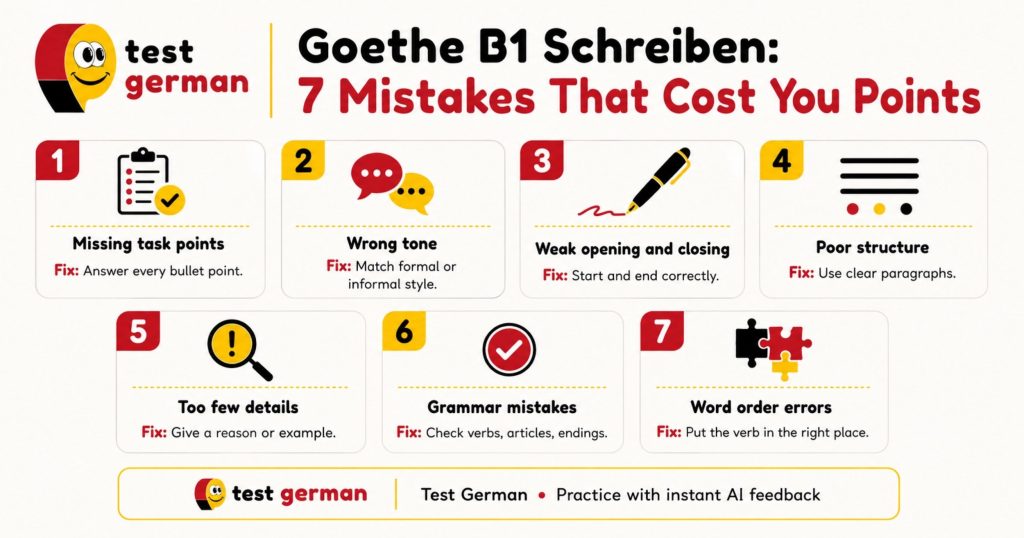
8. One solid block of text
Kohärenz is a scored criterion, and paragraphing is the cheapest way to show it. A wall of text hides whatever structure you had.
Fix: Greeting. One short opening. One or two content paragraphs. One closing line. Even in 80 words.
9. Joining every sentence with und
Und connects, but it doesn’t show a relationship. Examiners are looking for reason, contrast, consequence, addition.
Fix: Four connectors, four jobs. weil (reason), deshalb (result), aber (contrast), außerdem (addition).
Beispiel Der Kurs ist günstig. Außerdem liegt die Schule in der Nähe von meiner Wohnung.
10. Losing the verb after a connector
Plenty of B1 candidates know weil and still put the verb in the wrong place. One habit, repeated ten times, damages the whole Strukturen score.
Fix: Learn connectors in two groups. After weil, dass, wenn, obwohl the verb goes last. After deshalb, dann, außerdem the verb stays in position two.
Beispiel Ich komme nicht, weil ich arbeiten muss. Ich muss arbeiten. Deshalb komme ich nicht.
11. Building sentences with four ideas in them
Long sentences at B1 usually collect errors: a case here, a verb position there, a missing comma. Clarity drops and accuracy drops together.
Fix: One main idea per sentence. Maximum one subordinate clause.
Beispiel Schwach: Der Kurs beginnt früh und ich arbeite bis 17 Uhr und deshalb ist es schwierig für mich, weil ich müde bin. Besser: Der Kurs beginnt früh. Das ist schwierig, weil ich bis 17 Uhr arbeite.
12. Living on gut, schön, machen, haben
These words are fine. Using them eleven times is what pulls Wortschatz down.
Fix: Build small word families for the topics that keep coming back — Kurs, Arbeit, Wohnung, Freizeit, Gesundheit. Only swap in words you’re sure of.
Beispiel Statt Der Kurs ist gut: Der Kurs ist praktisch. Der Kurs ist gut organisiert. Der Kurs ist hilfreich.
13. Translating sentence by sentence from your first language
Direct translation produces word order that isn’t wrong exactly, but isn’t German either — plus false friends and the wrong prepositions.
Fix: Learn phrases as whole units, especially verb + preposition.
Beispiel sich für einen Kurs anmelden, sich auf die Prüfung vorbereiten, an einem Termin teilnehmen. Don’t assemble these word by word.
14. Capitals, umlauts, ß
German nouns are capitalised. Prüfung without the umlaut and Spass instead of Spaß are noticed. So is a missing comma before weil.
Fix: Reserve the last three minutes for one pass that looks at nothing but spelling and capitals.
Check: Spaß, Wohnung, Prüfung, außerdem, Grüße, Termin, Bewerbung
15. Reading the correction and moving on
This is the mistake that keeps the other fourteen alive. Understanding an error is not the same as unlearning it.
Fix: Rewrite the whole text after feedback — not just the corrected line. Then do a comparable task two or three days later and see whether the error returns.
Keep an error log with four columns: error / correction / rule / your own new example. The fourth column is the one that does the work.
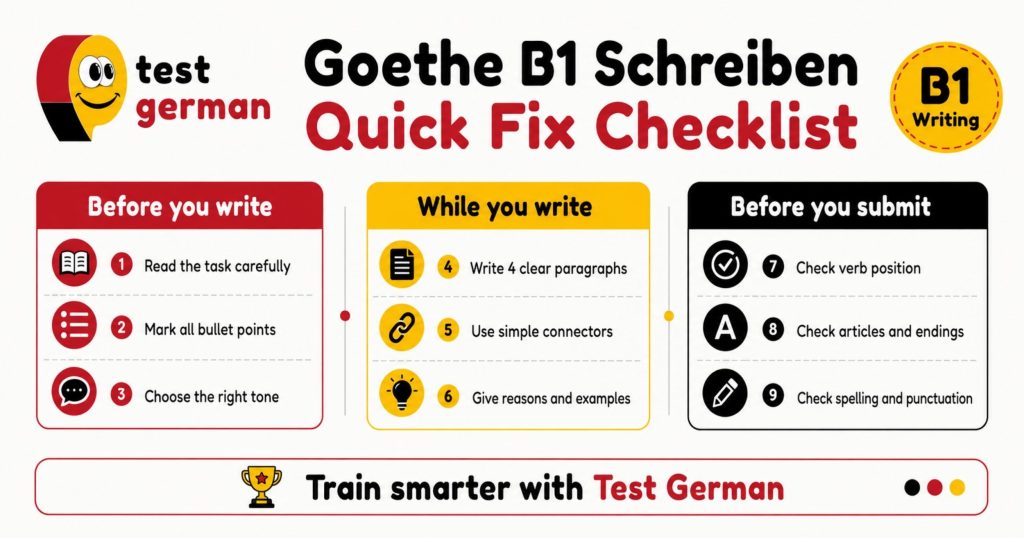
A 60-minute plan that holds up under pressure
- Minute 0–3. Read all three tasks. Decide the order. Most candidates do Aufgabe 3 first, because it’s short and takes the time pressure off.
- Aufgabe 3 (12 min). Two content sentences, correct Anrede and Gruß, roughly 40 words. Don’t decorate it.
- Aufgabe 1 (20 min). Three bullets, three numbered ideas, du throughout, roughly 80 words.
- Aufgabe 2 (20 min). State your opinion in the first sentence, give one reason and one example, close with a short conclusion. Roughly 80 words.
- Last 5 minutes. Content check first: are all bullets covered? Then verbs, then noun capitals, then commas.
Don’t add new ideas in the final minutes. Every new sentence written under pressure carries new errors.
From weak to exam-ready: one Aufgabe 3
Task: Your course teacher, Frau Müller, has invited you to a meeting about your learning goals. You can’t attend. Apologise politely and explain why. Ca. 40 words.
Weak version
Hallo Frau Müller, ich kann nicht kommen. Ich bin krank. Tschüss, Lina
Wrong greeting for a formal email. No apology formula, no closing formula, and the reason is one word long. Erfüllung and Kohärenz both take the hit.
Improved version
Sehr geehrte Frau Müller,
leider kann ich am Dienstag nicht zum Gespräch kommen. Ich habe an diesem Tag einen wichtigen Arzttermin. Ich entschuldige mich für die Umstände und melde mich nächste Woche wieder bei Ihnen.
Mit freundlichen Grüßen Lina Yilmaz
40 words. Both content points covered, formal register held from first word to last, and every structure in it is one a B1 candidate can control. Nothing fancy. Nothing risky.
What useful feedback should tell you
A grammar checker tells you a comma is missing. That’s the fourth criterion, and the smallest one.
Feedback that moves your score tells you whether you covered all three bullets, whether your register slipped, whether the reader can follow your order of ideas, and whether your vocabulary repeats. In other words: whether you’d pass, and where the gap is.
TestGerman marks exam-style Goethe, telc and DTZ writing tasks against those criteria and explains each correction in your own language — 18 are available, including Turkish, Arabic, Ukrainian, Farsi and Somali. Reading a correction in a language you only half understand is not feedback. It’s a second exercise.
Whatever tool you use, the sequence is what matters: write, get feedback, rewrite the whole text, repeat the same task type a few days later.
Seven days, one weak area at a time
| Day | Focus | Task |
|---|---|---|
| 1 | Erfüllung | One Aufgabe 1. Check all three bullets before you look at grammar. |
| 2 | Register | One Aufgabe 3 at 40 words. Formal only. |
| 3 | Connectors | Rewrite ten of your own sentences using weil, deshalb, aber, außerdem. |
| 4 | Word order | Twenty sentences: ten with the verb last, ten with the verb in position two. |
| 5 | Under time | All three tasks in 60 minutes. Timer on, phone away. |
| 6 | Rewrite | Correct day 5, then rewrite all three texts in full. Start your error log. |
| 7 | Second run | A new set of three tasks. Compare against day 5. |
Repeat the week, changing only the topics. Two or three timed sets are worth more than fourteen casual ones.
Conclusion
Goethe B1 Schreiben rewards control, not ambition. Cover every bullet. Hit the length. Hold the register. Use grammar you can actually steer.
The fifteen mistakes above are common because they’re structural, and they’re fixable for the same reason. Candidates who improve fastest aren’t the ones who learn more grammar. They’re the ones who stop writing blind: plan, write, read the feedback, rewrite, and come back to the same task type until it stops going wrong.
Ready to try one? Start a free TestGerman demo and write a Goethe-style B1 task — you’ll get it back marked against the same four criteria, in your language.
FAQ
How many points do I need to pass Goethe B1 Schreiben?
60 out of 100 in the Schreiben module. Each of the four modules is passed separately.
How long is the writing module?
60 minutes for all three tasks: 20 minutes for Aufgabe 1, 25 for Aufgabe 2, 15 for Aufgabe 3. You can start with any of them.
How many words should I write?
About 80 for Aufgabe 1 and Aufgabe 2, about 40 for Aufgabe 3.
Does my grammar have to be perfect?
No. Strukturen is one of four criteria. A text with a few errors that covers every bullet in the right register normally scores better than a flawless text that misses a point.
Can I memorise a model answer?
Memorise greetings, closings and connector patterns. Not whole texts. A memorised answer that doesn’t match the bullets loses exactly where it hurts most.
Should I use complex connectors?
Only the ones you can place the verb after correctly. Weil used right beats obwohl used wrong.
How often should I practise?
Two or three timed sets a week, each followed by a full rewrite. Frequency matters less than the rewrite.
Can AI feedback replace a teacher?
No. It gives you fast, repeatable correction between lessons, which is where most practice actually happens. A teacher adds judgement, strategy and accountability that software doesn’t.
Sources
- Goethe-Institut, GOETHE-ZERTIFIKAT B1 Modellsatz Erwachsene (Schreiben, Kandidaten- und Prüferblätter)
- Goethe-Institut, GOETHE-ZERTIFIKAT B1 Durchführungsbestimmungen
Disclaimer:
Dieser Blog dient ausschließlich zu Informations- und Aufklärungszwecken. Die Inhalte können durch andere Quellen überprüft werden. Der Autor übernimmt keine rechtliche Verantwortung für Entscheidungen, die auf Grundlage dieser Informationen getroffen werden.