Choosing the right German exam for professional recognition in Germany is a key step for many skilled professionals. If you hold a diploma from another country, you may need official recognition before you can work in your field. This process checks whether your qualification matches German standards.
Many applicants focus only on documents. They collect diplomas, translations, and work papers — and forget the language part. Your documents prove your profession, but your German proves you can handle daily life and your job.
Regulated professions in particular demand clear communication. Healthcare, education, and social work often require B2 or specialised professional German, so choosing an exam too quickly can cost you time and money.
This guide explains how recognition and German exams work together and helps you set a clear language goal.
What Professional Recognition Means in Germany (Anerkennung)
Professional recognition means that a German authority checks your foreign qualification and compares your diploma with its German equivalent. The process can include documents, translations, certificates, and sometimes extra training.
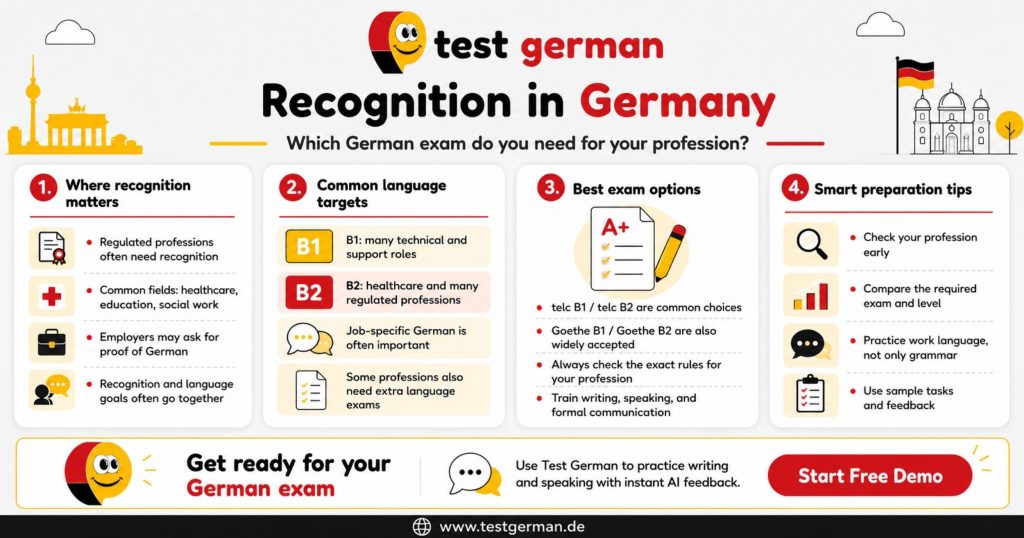
Some professions require recognition before you are allowed to work. These are called regulated professions — doctors, nurses, teachers, and certain engineering roles, for example.
Many other jobs are non-regulated. Here, formal recognition is usually not required, although employers can still ask for proof of your qualification.
Check your profession early. Find out whether your job is regulated, identify the responsible authority, and only then look into the language requirement. There is no single rule that applies to every job — the right exam depends on your specific case.
Where German Exams Enter the Recognition Process
Language certificates come into play in two ways: an authority may request a specific German level, or an employer may expect a certificate.
Do not guess. Contact the exact office responsible for your profession and your federal state. Germany’s sixteen states can set different requirements, so what applies in Bavaria may differ from North Rhine-Westphalia.
Professional language often matters more than general German. A nurse must understand patients, a teacher must explain lessons, and a customer adviser must handle complaints. General B1 may not be enough for some careers — but it still gives you a strong base for daily and workplace communication.
Your exam choice should always match your real career goal, not just a level on paper.

B1, B2, and Job-Related German (Berufssprache)
B1 shows that you can handle most daily situations. It helps with integration and basic work topics: writing simple emails, explaining common problems, and talking about your work experience.
B2 demonstrates stronger independence. At this level, you can explain details clearly, defend opinions, and write more polished formal emails.
Job-related German (Berufssprache) means German for your specific profession. It covers technical vocabulary, polite phrases, reports, forms, and workplace conversations. A nurse uses words about symptoms, a teacher uses classroom language, a mechanic works with technical instructions, and an office worker writes formal correspondence.
Your exam preparation should therefore include your profession. Do not learn grammar in isolation — connect German with your real working life.
Goethe, telc, and Professional German Exams
Both Goethe and telc exams prove general German levels. Some telc formats focus more on work situations, which makes them attractive for career-oriented learners.
Which certificate is accepted, however, depends on the authority. Some offices accept several certificates; others ask for one specific exam. Always check the official requirement before booking.
Certain professions also need special language exams. Doctors, for example, usually take a professional language exam (Fachsprachprüfung), and some healthcare roles demand strong job-related German beyond a standard certificate.
Treat Goethe or telc as one part of your plan. A certificate proves your level — but real preparation also builds the vocabulary and speaking skills you will need at work.
Writing and Speaking for Professional Recognition
Many learners concentrate on grammar alone. Recognition and career life, however, demand practical communication: writing an email to an authority, explaining your work experience, or answering questions in an interview.
Practice short, clear answers with a simple structure:
- Explain your role.
- Describe your tasks.
- Give one example.
- State your goal in Germany.
Prepare answers about your education and work experience, and practice polite questions for offices and employers. This structure makes you sound clear and professional — and it reduces stress before real conversations.
How Test German Helps
Test German supports learners who need exam-style practice. You can train writing and speaking and receive instant feedback in your own language.
The feedback highlights grammar mistakes, word order, task relevance, and vocabulary. You can repeat your practice as often as you like before the real exam.
This matters because many learners repeat the same mistakes for months. Clear feedback helps you improve faster.
Start a free Test German demo here!

A Step-by-Step Recognition Language Plan
- Identify your profession in Germany and check whether it is regulated.
- Find the responsible recognition office for your state.
- Ask which German certificate or language proof they expect. This prevents wrong exam choices and saves time and money.
- Collect professional vocabulary from your field. Write a list of fifty words and build ten example sentences. For healthcare, use symptoms and patient care; for education, classroom and parent communication; for technical jobs, tools and safety instructions.
- Practice explaining your foreign qualification in German. Say where you studied, what you learned, and which tasks you performed. This helps in interviews and recognition talks.
With these steps, your preparation becomes practical and focused instead of theoretical.
Common Mistakes During Recognition Preparation
- Thinking recognition is only about documents. Language often decides your daily success at work.
- Learning general German without job context. General German helps, but professional vocabulary gives you confidence.
- Preparing for B2 without fixing B1 gaps. Weak foundations make your writing weak. Review word order, cases, and connectors, and practice short formal emails.
- Neglecting speaking. Recognition often leads to interviews, adaptation courses, or daily work communication. Practice short professional explanations every week.
- Relying on one online list. Requirements differ by state and profession — always verify the exact requirement with the responsible office.
How to Measure Your Progress
Measure your progress weekly. Record one speaking answer, write one short text, then compare your old and new answers.
Check three points:
- Did you answer the task?
- Did you use clear word order?
- Did you make fewer repeated mistakes?
Track important vocabulary as well. Choose twenty words per week and use them actively in sentences — reading them is not enough. Active use turns vocabulary into a real-life skill and shows you your weak points before exam day.
Final Practice Tip Before Action
Before you send a message or join a conversation, practice once aloud and write down the exact sentence you need.
This small step reduces stress because your brain already knows the words. Check the verb position, too — German places the verb in a fixed position, and one quick check can improve your whole message.
Keep your sentences short. Short sentences sound clear, polite, and confident — exactly what recognition offices, employers, and job interviewers want to hear.
Conclusion
There is no single German exam for professional recognition in Germany that fits everyone. Your profession, federal state, employer, and authority all shape the requirement, so verify the exact certificate before booking.
For most career paths, B1 and B2 remain strong goals, and job-related German (Berufssprache) often decides your confidence at work.
Start practicing real writing and speaking tasks early, and build vocabulary for your profession. Your recognition journey will become clearer, safer, and more useful for your career.
Also explore the AI-supported learning paths of Tuees: https://wilhelmdigital.de/services/tuees/
FAQ
What is professional recognition in Germany (Anerkennung)? Professional recognition means Germany checks your foreign professional qualification. The authority compares it with a German qualification.
Do all professions need professional recognition in Germany? No. Regulated professions usually need it. Many non-regulated jobs do not require formal recognition, although employers may still ask for proof.
Which German level do I need for professional recognition? It depends on your profession and federal state. B1 or B2 often helps, but some professions need a special language exam.
Which German exam is best for professional recognition in Germany? There is no single best exam for everyone. Goethe and telc are common options, but you must check with the exact authority.
Is telc accepted for professional recognition in Germany? Many institutions accept telc. Acceptance depends on the profession, state, and authority, so always check before booking.
Do nurses need professional German in Germany? Yes. Nursing usually requires strong job-related German. Nurses must understand patients, explain care, and write clearly.
Should I learn job-related German before B2? Yes, you can start early. Add job vocabulary while you build B1 and B2 — this makes your German more practical.
Can Test German help with professional communication? Yes. Test German helps with writing, speaking, structure, and exam-style feedback, which supports your preparation for real tasks.
Disclaimer:
Dieser Blog dient ausschließlich zu Informations- und Aufklärungszwecken. Die Inhalte können durch andere Quellen überprüft werden. Der Autor übernimmt keine rechtliche Verantwortung für Entscheidungen, die auf Grundlage dieser Informationen getroffen werden.