

Introduction
Jobcenter and Employment Agency letters in Germany can feel stressful at first. Many learners open a letter and see long words, formal phrases, and important dates. Therefore, they feel nervous. However, you do not need perfect German to understand the main message.
You need a clear reading system. First, find the sender. Then find the deadline. After that, find what the office wants from you. In addition, learn the most common official words. This blog explains the process. It helps A2 and B1 learners understand official German letters with more confidence.
Why these letters feel difficult
Official letters in Germany often use formal language. They use long nouns and fixed phrases. In addition, they often include deadlines, file numbers, document requests, or appointment details. Because of this, many people try to translate every word. That usually creates more stress.
A better method is to read for function, not for perfection. Ask these questions first:
- Who sent the letter?
- Why did they send it?
- What do they want from me?
- When must I reply?
- Which documents must I send?
This method saves time. It also helps you focus on the real task.
Jobcenter and Employment Agency: What is the difference?
Many learners confuse these two offices. However, they do not always do the same job.
The Jobcenter often supports people who receive citizen benefits (Bürgergeld) or need long-term job support. The Employment Agency (Agentur für Arbeit) often supports job search, unemployment matters, training, and career services.
However, your exact situation depends on your personal status. Therefore, always check the letterhead first. It usually shows:
- the office name
- the address
- the contact person
- the file number
- the date
This information is important. In addition, keep every official letter in one folder. You may need it later.
The most important words to recognise first
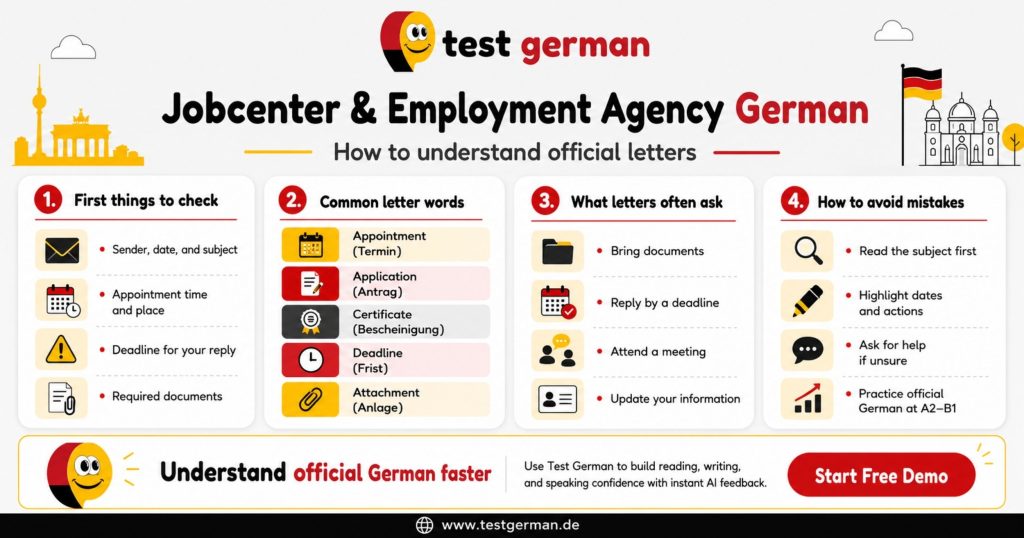
If you learn a few key words, official letters become much easier. Start with these:
- appointment (Termin)
- deadline (Frist)
- proof (Nachweis)
- application (Antrag)
- decision letter (Bescheid)
- documents (Unterlagen)
- cooperation (Mitwirkung)
- request / instruction (Aufforderung)
- reply / feedback (Rückmeldung)
These words appear again and again. Therefore, they are high-value words for A2-B1 learners.
You should also notice action verbs. For example:
- send (senden / einreichen)
- bring (mitbringen)
- appear / attend (erscheinen)
- reply (antworten / zurückmelden)
- prove (nachweisen)
These verbs tell you what you must do.

How to read an official letter step by step
You do not need to read the whole letter in order. Instead, use this five-step system.
1. Check the sender
Look at the top of the letter. Is it from the Jobcenter? Is it from the Employment Agency? Is it from another office?
2. Check the date
Find the date of the letter. This helps you understand how urgent it is.
3. Find the deadline
Look for words like “frist,” “bis spätestens,” or a clear calendar date.
4. Find the action
What must you do? Send documents? Attend an appointment? Answer a question?
5. Check the attachments or required documents
Look for words like Unterlagen, Nachweis, Anlage, or Bescheinigung. This method works well because most official letters follow a fixed structure.
What official letters usually ask you to do
Most letters from these offices ask for one of a few common actions. If you understand the type of request, the whole letter becomes easier.
1. They may ask you to send documents
For example:
- salary proof
- rent documents
- bank papers
- work contract
- ID or passport copy
2. They may invite you to an appointment
Look for:
- date
- time
- place
- what to bring
3. They may make a decision
This often appears in a Bescheid. It may explain approval, rejection, payment, or a change.
4. They may ask for confirmation or cooperation
This means they need something from you before they continue your case. Therefore, the main question is simple: What does this office want me to do next?
A simple reply strategy for A2-B1 learners
Many learners think they need complex German to answer official letters. That is not true. Simple and clear German works well in many situations. You can use short formal messages such as:
Situation | German template | When to use it |
Sending documents | Sehr geehrte Damen und Herren, vielen Dank für Ihr Schreiben. Ich sende Ihnen die gewünschten Unterlagen. Bitte bestätigen Sie den Erhalt. Mit freundlichen Grüßen. | When the office asks you to send documents, certificates, or proof. |
Asking for a new appointment | Sehr geehrte Damen und Herren, leider kann ich den Termin nicht wahrnehmen. Ich bitte um einen neuen Termin. Mit freundlichen Grüßen. | When you cannot attend an appointment and need another date. |
Asking a question | Sehr geehrte Damen und Herren, ich habe eine Frage zu Ihrem Schreiben. Könnten Sie mir bitte weitere Informationen senden? Mit freundlichen Grüßen. | When you do not understand something in the letter and need clarification. |
These answers are short, polite, and useful. Therefore, writing practice helps in real life, not only in exams.
A practical checklist for every letter
To avoid stress, create one small checklist for every new letter. Write these five points in a notebook or on your phone:
- Office name
- Date of the letter
- Deadline
- What they want
- What I already sent
For example:
- Office: Jobcenter
- Date: 8 July
- Deadline: 15 July
- Action: send rent documents
- Status: sent by email
This method is very practical. In addition, save a photo or scan of every document you send. If you answer online, save the confirmation. If you answer by post, keep proof of sending. Therefore, official German becomes a process, not a panic moment.

Common mistakes people make
Many learners make the same mistakes with official letters. If you avoid them, you already improve your situation.
Mistake 1: Ignoring the letter
Some people feel afraid and do nothing. However, silence can create bigger problems.
Mistake 2: Missing the deadline
Always mark the Frist in your calendar.
Mistake 3: Sending papers without explanation
A short message helps the office understand your answer.
Example: (Hiermit sende ich Ihnen die gewünschten Unterlagen.)
Mistake 4: Translating every word
This wastes time. Instead, focus on dates, actions, and documents.
Mistake 5: Throwing letters away
Keep all official letters in one folder. This protects you later.
A2-B1 study ideas for official German
If you want to improve faster, study official German in a focused way. You do not need to study everything.
Here are some good practice ideas:
- learn 10 official words each week
- practise one short reply email
- highlight deadlines in sample letters
- make a list of common document names
- practise appointment phrases
- learn how to ask polite questions
You can also group vocabulary by topic:
Appointment words
- Termin
- absagen
- verschieben
- teilnehmen
Document words
- Unterlagen
- Nachweis
- Bescheinigung
- Kopie
Action words
- senden
- einreichen
- mitbringen
- antworten
This method makes learning easier because the words belong together.
How Test German helps:
Test German helps learners practically practise reading and writing. It supports A2-B1 learners with exam-style tasks and instant AI feedback in their own language.
This feedback helps with:
- grammar
- word order
- connectors
- task relevance
- sentence clarity
Moreover, learners can practice writing short formal emails and simple written answers. This is useful for both exam preparation and daily life in Germany.
Start a free Test German demo here!
Conclusion
Jobcenter and Employment Agency letters in Germany become easier when you use a clear system. You do not need to understand every legal word. However, you must find the sender, the deadline, the requested documents, and the action.
Therefore, learn the most common official words first. In addition, practice short and polite replies. This helps you respond on time and protect your rights. With regular practice, Jobcenter and Employment Agency letters in Germany become less stressful and much more manageable.
For structured courses and AI-supported learning paths, visit Tuees:
FAQ
What is a Frist in a German letter?
A Frist is a deadline. You must answer or send documents before that date.
What does Nachweis mean?
Nachweis means proof. It can be a certificate, payment paper, contract, or another official document.
What is a Bescheid?
A Bescheid is an official decision from an authority.
Do I need B1 to understand Jobcenter letters?
B1 helps a lot. However, A2 learners can understand many letters if they know the most important vocabulary.
How can I ask for a new appointment in German?
You can write: (Ich bitte um einen neuen Termin.)
Should I keep Jobcenter and Employment Agency letters?
Yes. Keep all letters, dates, and sent documents in one folder.
Can Test German help with official letters?
Yes. Test German can help you practise formal writing and understand your mistakes more clearly.
Disclaimer:
Dieser Blog dient ausschließlich zu Informations- und Aufklärungszwecken. Die Inhalte können durch andere Quellen überprüft werden. Der Autor übernimmt keine rechtliche Verantwortung für Entscheidungen, die auf Grundlage dieser Informationen getroffen werden.